CNMI
Apatang leans on pragmatic strategy to guide CNMI recov
By Bryan Manabat
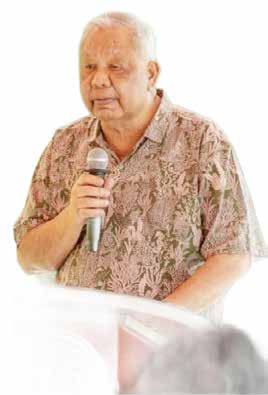
Saipan—Gov. David M. Apatang is steering the Commonwealth of the Northern Mariana Islands through economic uncertainty with a pragmatic approach to governance.
“I’m not perpetually stuck in a single leadership style,” Apatang told the Pacific Island Times. “Different situations call for different ways of doing things.”
In terms of economy policy, Apatang is seeking to deviate from his predecessor approach. He signaled a potential shift to the tourism strategy, suggesting the CNMI revisit its relationship with China.
“I believe the pivot from the China market is worth revisiting,” he said. “The CNMI may be a viable market to sustain the CNMI visitor and hospitality industry, which I am fully aware are reeling and struggling to stay afloat.”
The Chinese tourism market made up 50 percent of the islands’ visitors before the Covid-19 pandemic hit. Two months after assuming office in 2023, Apatang announced his administration’s policy to reduce reliance on Chinese tourists and strengthen other Asian markets. The CNMI business community, however, has not pleased with the policy and has since advocated for reviving focus on the China market.
To stimulate economic activity, Apatang is working to restore visitor arrivals to pre-pandemic levels and improve the business climate. His administration is looking at streamlining application and permit processes and offering incentives, such as favorable tax and land-lease terms, to attract new investors.
Since taking office on July 23, Apatang has faced urgent fiscal challenges, including keeping the government operational amid declining revenues and rising costs.
“One of great challenge since becoming governor was trying to keep the CNMI government open and operating with available financial resources,” he said. Apatang assumed full executive authority following the death of Gov. Arnold I. Palacios in July. He will serve the remainder of Palacios’ unfinished term until 2024.
Apatang has emphasized practicing fiscal discipline and transparency as the foundation of his administration.
However, he faced public outrage after asking the legislature to pass an annual salary of $80,000 for himself and, Henry Hofschneider, 30 days before issuing a direct sweeping cost-cutting measures. A requested amount was $20,000 above the government’s $60,000 pay ceiling; the governor later withdrew the request following the backlash.
Other members of his administration, including chief of staff Justin Puel and resources, including Lt. Gov. Denni Meneses, Homeland Security Policy of Jesus Dela Cruz and Lt. Justin Paul Mizutani of the Department of Fire and Emergency Medical Services. Four others, Henry Sablan Hofschneider, Laris Lashing, Sebalan Flores, Teresita Borja Camacho, and Isolda Dela Cruz Macaranas, were charged with misconduct in public office in a separate case.
Apatang, who previously served as a longtime mayor and lieutenant governor, said his approach remains consistent: “I have always been cautious, attentive and transparent in carrying my responsibilities — always considering the best interest of the CNMI and its people.”
Apatang pledged to continue federal relationships, including with the White House and the Department of Interior’s Office of Insular Affairs and the Department of Defense.
“I commit to the same level of transparency, if not more, and promise to work together,” he said. “Good relationships are built on the foundation of honesty, transparency, consistency, trust, faith, respect and clear and open communication.”
Apatang identified three core priorities for the remainder of his term: ensuring public safety, protecting the health and welfare of residents, and supporting the economic opportunity.
“Every person and business must have a chance to make a living and live better in Saipan. My administration is very concerned about the decline in our economic activities and presumed revitalization,” Apatang added. “We will continue to strive on ways to maintain the CNMI’s base population, keep businesses open and invest in new ones to start and thrive, and keep costs down and affordable.”
He is also pressing the Commonwealth Utilities Corp. to accelerate renewable energy development to lower electric costs. “I continue to pressure CUC to develop alternative energy production and the long-term goal of stabilizing long-term electricity rates than current,” he said.
Another big issue is the CNMI fiscal obligation to the Settlement Fund. The government is obligated to pay $200 million in Section obligation bond to retire the liability and ease pressure on the domestic fiscal and underlying some of the rest of the debt.
“This matter was one of the things we can do to bring some immediate relief,” he said. “We need to allow time during this process to see the full picture and be able to secure the full and debt to guide economic recovery.” Apatang also reconvened the Governor’s Council on Economic Advisers and directed the office to attract new investments that support the CNMI’s path to recovery and bring back confidence and security.
Apatang said his governance is rooted in listening to community concerns and responding with practical solutions that help the struggles of residents and businesses. “I will welcome anyone who wants to talk, and I encourage my Cabinet to be open too,” he said. He emphasized transparency as essential to maintaining public trust, noting his press conferences and Cabinet meetings to share updates and hear feedback.
In a bid to prevent a government shutdown, Apatang signed off on a $179 million budget for fiscal year 2026 on Jan. 30, but urged lawmakers to pass the revised spending plan based on lower revenue projections of $156 million.
On Oct. 1, he issued a directive instructing executive departments to adjust government austerity protocols, including reduced work hours, a hiring freeze, review of payrolls, overtime restrictions and a ban on non-essential purchases. He also urged government employees and families affected by furloughs and reduced hours to bear with the hardship but urged unity.
“I ask everyone to bear with me through these tough times, we are all going through,” he said. “I am confident that by partnering each other, we will weather any hardships that come our way.”
He added that the CNMI has endured economic downturns before. “As in the past, we will need coordination and reduced to levels that our available resources could support.”
“Our CNMI, where our economy is heavily reliant to outside economic inflows — as we do not have any industry to sustain us during periods of market contractions — we have to brace for immediate change,” Apatang said.
“This is necessary for us to survive. We must, as long as we stay together and support each other, bear the hardships together, we will bounce back.”