Bookshelf
By Cameron Hill
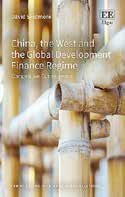
There have been libraries of academic books published over the last decade examining the various political, economic and military dimensions of competition between China and the West. By contrast, there have been comparatively few that provide an in-depth examination of how this competition has played out in the domain of aid and international development, and, more specifically, in development finance.
A new book, “China, the West, and the Global Development Finance Regime: Competitive Convergence,” written by David Skidmore, professor of Political Science at Drake University, is a welcome addition to a small but important body of literature.
Skidmore’s central argument is that China’s emergence as a competing (and leading) source of various forms of development finance in low- and middle-income countries has been, to date, largely characterized by a process of accommodation and adaptation within the established Western-led “liberal international order,” rather than one of fundamental challenge to that order.
“States, growing competition between China and the West) has not led to convergence but to convergence as the competition between the two sides has narrowed rather than expanded over the last two decades.”
The result has been the continuation, rather than the collapse of the postwar liberal international order-based development finance regime, albeit in a more plural form that more closely resembles the postwar state-oriented variant (“embedded liberalism”) than the more market-oriented one that dominated in the 1980s and 1990s (“neoliberalism”).
The book explores three arenas of contemporary competition to demonstrate this process of convergence: the evolution of Chinese bilateral development cooperation and funding for large telecommunications, as well as providing state backing for large telecommunications in the West’s response; China’s influence in the domestic social order (state-market relations) arrangements in the recipients of development finance and the emergence of the China-led multilateral financing, in turn, tilted its focus towards grant-based assistance and working with regional multilateral institutions such as the Pacific Islands Forum.
Skidmore’s book provides a carefully researched corrective to commentators who have continued to characterize China’s development competition as a straightforward challenge – an oceanic contest between a democratising West and an authoritarian China, and explores the role of state learning or adaptation of local approaches.
While Skidmore acknowledges that these differences have hampered U.S. and European responses to China, the question of whether they represent a binding constraint to mobilizing the scale of financial and political capital required to credibly compete with Beijing’s investments in the developing world is left unanswered.
Cameron Hill is senior research officer at the Development Policy Center. He has previously worked with DFAT, the Australian Parliamentary Library and ACFID. Here full article appeared on Devpolicy blog (devpolicy.org) from the Development Policy Center at The Australian National University.