Fiona Critchley, Chair of the Timber Doorsets Group at the Door & Hardware Federation and Head of Communications, Gerda Security Products, outlines key points of which to be aware.
THE CONSTRUCTION Products Reform White Paper places product safety at the centre of proposed reforms to the construction products regulatory regime. It identifies that only just over a third of construction products are currently regulated through designated standards and highlights ongoing concerns regarding incomplete, unclear, and misleading product information.
The Government's objective is to ensure that construction products are safe, trusted, and supported by accurate, accessible, and transparent information.
Although new standards and Digital Product Passports are expected from 2028/29, the existing designated standards remain applicable today. CPR 305/2011 continues in UK law and is policed by the Office for Product Safety and Standards (OPSS).
For designers, architects, Principal Designers, manufacturers, economic operators and the wider supply chain, understanding the applicable standards and evidence is essential to ensure that external pedestrian doorsets are correctly specified, manufactured and installed.
The compliance route depends on the type of doorset. There are three important categories:
- Standard external pedestrian doorsets, such as flat entrance/balcony doors and service-room doors;
- External pedestrian doorsets incorporating panic hardware; and
- External pedestrian doorsets requiring fire resistance and/or smoke control.
These categories have different assessment and verification requirements.
Designated Standards
Two designated standards apply:
- BS EN 14351-1:2006+A2:2016 — Windows and doors – Product standard, performance characteristics – Part 1: Windows and external pedestrian doorsets.
- BS EN 16034:2014 — Pedestrian doorsets, industrial, commercial, garage doors and operable windows – Product standard, performance characteristics – Fire resisting and/or smoke control characteristics.
BS EN 16034 cannot be used independently. Where fire resistance and/or smoke control is required, it must always be applied alongside another designated standard.
1. Standard External Pedestrian Doorsets
Standard external pedestrian doorsets without fire, smoke or panic-hardware requirements are covered by BS EN 14351-1:2006+A2:2016.
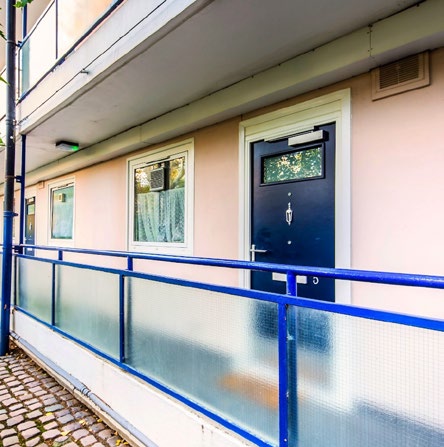
Examples include flat entrance or balcony doors; front entrance doors; and service-room doors.
These products are subject to AVCP System 3. This means the manufacturer or economic operator must ensure that initial type testing has been completed for the applicable Annex ZA essential characteristics. Testing must be undertaken by a UKAS-accredited test laboratory using the relevant test methods.
Applicable essential characteristics include: Thermal transmittance; Watertightness; Wind resistance; Air permeability; Acoustic performance; Dangerous substances. (Just to note: security is not an essential characteristic in Annex ZA.)
Where permitted, No Performance Declared (NPD) may be used. However, Thermal transmittance cannot be declared as NPD in the UK and must comply with Building Regulations.
For England, the current maximum U-values are 1.4 W/m²K for non-fire-rated external pedestrian doorsets; and 1.8 W/m²K for external pedestrian doorsets with fire resistance / smoke control.
Declaration of Performance
The Declaration of Performance (DoP) is the legal document under the Construction Products Regulation and provides the basis for UKCA or CE marking. It should identify the applicable designated standard; the manufacturer; the product and product reference; the intended use; the date of issue; and the applicable Annex ZA essential characteristics.
Marking is on the product or the packaging, or accompanying documentation.
2. External Pedestrian Doorsets with Panic Hardware
External pedestrian doorsets incorporating panic hardware remain within BS EN 14351-1, but they are subject to AVCP System 1 rather than System 3.
This is because of the safety-critical characteristic of ability to release. An Approved Body is responsible for assessing ability to release and is also involved in sampling assessment of relevant characteristics, including: Thermal transmittance; Watertightness; Resistance to wind load; Air permeability; and Acoustic performance.
3. External Pedestrian Doorsets Requiring Fire Resistance and/or Smoke Control Performance
Where an external pedestrian doorset requires fire resistance and/or smoke control, both designated standards apply:
- BS EN 14351-1:2006+A2:2016
- BS EN 16034:2014
BS EN 16034 cannot be used on its own.
These doorsets are subject to AVCP System 1 which means that they require Approved Body involvement for factory production control and product sampling prior to testing. Testing is undertaken at a UKAS-accredited test house using the relevant standards: BS EN 1634-1 for fire resistance testing and BS EN 1634-3 for smoke leakage testing.
Fire classifications are established in accordance with EN 13501-2+A1:2016, based either on a Direct Field of Application, using a single test, or an Extended Field of Application (EXAP). The EXAP route involves several primary tests, with results considered strictly in accordance with the applicable EN 15269 EXAP rules. The resulting EXAPs and classification reports are subsequently considered by the Approved Body.
Classifications include: E: Fire integrity; EW: Fire integrity and limited heat radiation; EI: Fire integrity and full insulation, with the duration in minutes stated thereafter.
Smoke classifications include Sa for ambient temperature smoke leakage, and S200 for hot smoke leakage.
The Approved Body issues the Certificate of Constancy of Performance (CoCP), which the manufacturer uses to support their declaration of fire and smoke performance in the DoP.
Marking for EN 16034 includes the UKCA or CE Mark with the registered number of the Approved Body on the product.
System House and Cascaded Test Evidence
Many fire door producers operate as fabricators or assemblers using designs, components and test evidence developed by a System House. A System House may develop and test the doorset design, hold the master CoCP and cascade approved designs and evidence to individual producers.
However, cascaded evidence does not remove the producer’s own regulatory responsibilities. A producer must not assume that a BS EN 16034 CoCP is sufficient evidence of compliance for the complete external fire-rated pedestrian doorset.
The CoCP provides evidence for the fire resistance and/or smoke-control performance covered by BS EN 16034. It does not, by itself, demonstrate compliance with the other applicable requirements of BS EN 14351-1.
The Doorset must also meet BS EN 14351-1
The producer must ensure that the doorset design has appropriate test evidence against the relevant performance standards required by BS EN 14351-1:2006+A2:2016. Essential characteristics include: Thermal transmittance; Air permeability; Watertightness; Resistance to wind load; and Acoustic performance.
The evidence must relate to the doorset design being manufactured, including its relevant performance standards, and the finished product must remain within the scope and limitations of the supporting evidence.
A BS EN 16034 CoCP is therefore not, by itself, evidence that the complete external fire-rated pedestrian doorset complies with BS EN 14351-1.
Conclusion
The compliance route for an external pedestrian doorset depends on its characteristics and intended use.
A standard external pedestrian doorset, such as a flat entrance/balcony door, front door or service-room door, is covered by BS EN 14351-1 and AVCP System 3.
An external pedestrian doorset incorporating panic hardware remains under BS EN 14351-1, but is subject to AVCP System 1, requiring Approved Body involvement because of the ability-to-release characteristic.
Where fire resistance and/or smoke control is required, the doorset must comply with both BS EN 14351-1 (with either of the two afore-mentioned systems) as well as BS EN 16034 which is subject to AVCP System 1.
The Declaration of Performance remains the legal document. For fire-rated doorsets, the CoCP provides important third-party evidence for fire and smoke performance under BS EN 16034, but it does not replace the producer’s responsibilities under BS EN 14351-1.
Where System House arrangements and cascaded evidence are used, producers must ensure that the doorset design has appropriate test evidence against the relevant performance standards required by BS EN 14351-1, as well as appropriate evidence for its BS EN 16034 fire and smoke performance.
Ultimately, compliance depends on a complete chain of evidence linking the tested design, relevant performance testing, manufacturing process, certification, declared performance and final product.