~by Julia Pearson
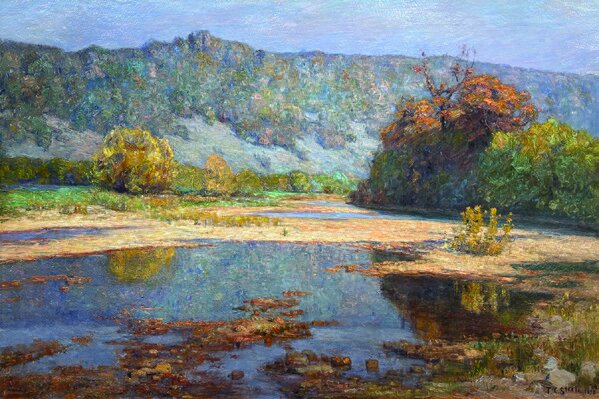
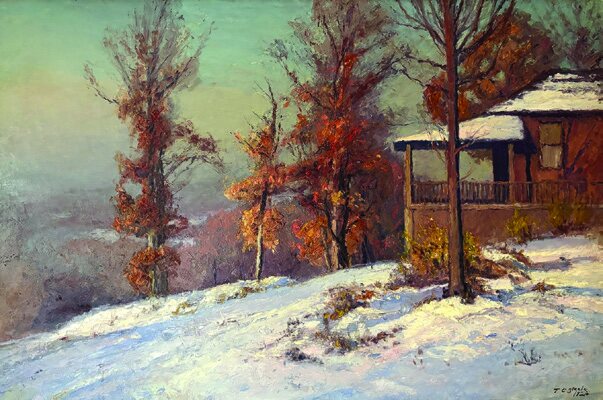
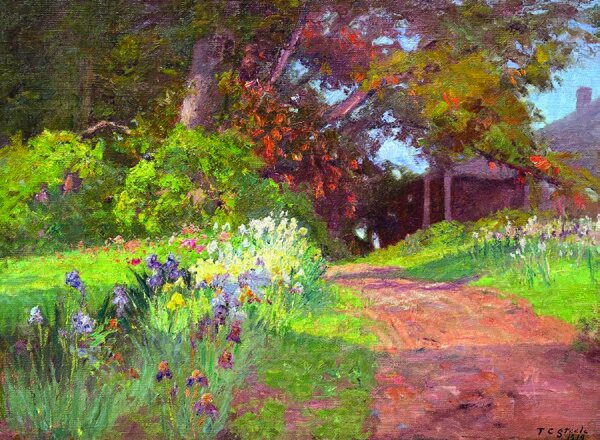
Lovers of art, history, nature, and Brown County have until Sept. 20 to experience the largest exhibition of Theodore Clement (T.C.) Steele’s work presented in the past century. The collection has been on display at the Brown County Art Gallery since July 19, commemorating the 100th anniversary of Steele’s death and also the 100th anniversary of the birth of the art gallery.
Visitors will be struck by Steele’s vibrant, plein air Impressionist landscapes that capture the changing seasons, unique light, and natural beauty of Indiana.
The Steele exhibition will be followed by a gallery founders Collectors’ Showcase in October.
More than 70 paintings by T.C. Steele, known as “Indiana’s Master Impressionist,” have been assembled from galleries, libraries, museums, universities, and private collections. Spanning his artistic journey from Munich to Brown County, the exhibition offers a rare opportunity to experience the breadth and evolution of Steele’s work.
Steele, a major figure in American Impressionism, was widely revered at the time of his death at age 78 and was often regarded as the “Dean of Indiana Painters.” In May 1926, while working on a painting, he became seriously ill. Treatment at a Terre Haute clinic proved unsuccessful, and he returned to his home in Brown County, where he spent his final weeks surrounded by the landscape that had long inspired his art.
Steele was a core member of the Hoosier Group, alongside J. Ottis Adams, William Forsyth, Otto Stark, and Richard Gruelle, and played a pivotal role in bringing national recognition to the landscapes and artistic traditions of the Midwest.
T.C. Steele was born in Gosport, Ind., on Sept. 11, 1847. His father, Sam Steele, was a farmer and saddle maker. His mother, Harriet, raised five children. When T.C. was five years old, the family moved to Waveland, Ind., seeking better educational opportunities for their children.
Steele’s interest in art emerged at an early age. Fascinated by the work of an itinerant sign painter who passed through Waveland, he followed the craftsman as he worked.
Family members supported his growing passion for painting. He enrolled at the Waveland Academy, where his artistic abilities developed quickly. By age 13 he had been appointed teacher of arts.
Tragedy struck the family when Steele’s father died the following year. Despite the financial hardships that followed, his mother remained committed to nurturing his artistic ambitions. Theodore was able to continue with his art studies again as soon as his brothers were old enough to take over the farmwork.
While at the academy, Steele met Libbie Lakin, who would become his first wife. After their marriage in 1870, the couple moved to Battle Creek, Mich., where he supported his family by painting commissioned portraits and commercial signs. They had two children at that time, Rembrandt (Brandt) and Margaret (Daisy).
The family later moved to Indianapolis, where Steele continued to earn a living as a portrait painter. It was there that their third child, Shirley, was born.
Recognizing his potential, a group of Indianapolis businessmen provided financial support for Steele to pursue formal artistic training abroad, with the understanding that he would return to Indianapolis afterward. As a result, the family relocated to Munich, Germany, where Steele studied from 1880 to 1885, receiving the intense training that would help shape his distinguished career.
After returning to Indiana, Steele continued painting portraits, but over time, his landscapes gained recognition and attracted buyers.
A profound personal loss came in 1899 with the death of his wife, Libbie. Steele struggled with grief but continued to paint every day. During this period, he met Selma Neubacher, the sister-in-law of his daughter, Daisy.
The two married in 1907 and settled in the hills of Brown County. They built a home they called The House of the Singing Winds, along with a studio. The property is now the T.C. Steele State Historic Site, between Nashville and Bloomington.
In 1922, Indiana University appointed Steele as its first artist-in-residence, recognizing his stature as one of the state’s most accomplished painters. Four years later, following his death, a memorial service in Indianapolis drew many of Indiana’s leading artists, civic leaders, and business figures.
Fellow artist Will Vawter carried Steele’s ashes back to Brown County. They were interred on the hillside below The House of the Singing Winds and Steele’s studio in a ceremony attended by approximately 600 people. Today, the gravesite remains a place of reflection for admirers of his work. Its simple inscription, “Beauty Outlives Everything,” serves as a fitting tribute to an artist whose legacy continues to inspire generations.
The Brown County Art Gallery’s annual Collectors’ Showcase will open on Oct. 3. The exhibition will be accompanied by a centennial catalog that chronicles the gallery’s history, with special emphasis on the early artists who followed T.C. Steele to the scenic landscapes of southern Indiana. These founding painters formed the nucleus of the Brown County Art Colony, establishing a vibrant artistic community.
Work by the gallery’s founders will be showcased, including paintings by Charles Dahlgreen, Ada Shulz, E.K. Williams, and Will Vawter, to name a few.
Local Brown County artist Tim Greatbatch will also present a collection of canvases inspired by a three-year exploration of the county’s roads, landscapes, village scenes—both interior and exterior settings. His work reflects an intimate connection to the region, capturing its character, changing seasons, and quiet beauty.
Greatbatch often begins his creative process by hiking through the countryside with a camera and sketchpad, gathering reference material and recording impressions of the places he encounters. He then returns to his home and studio atop a ridge near Nashville, where he transforms those observations into paintings, frequently working late into the evening to bring each scene to life on canvas.
The Brown County Art Gallery is located at One Artist Drive, Nashville. Gallery Hours are: Monday-Saturday, 10 a.m.–5 p.m.; Sunday, noon–5 p.m. Admission and parking are free.
Visit browncountyartgallery.org for more information.
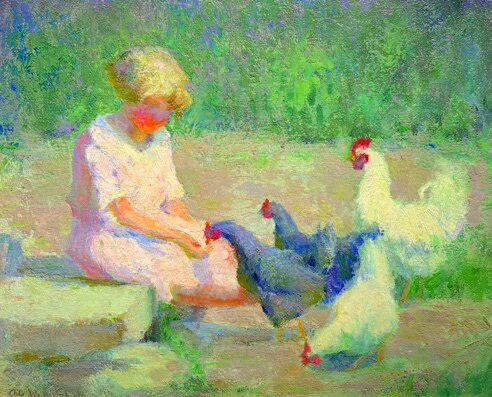
“Little Girl with Chickens,” by Ada Shulz.
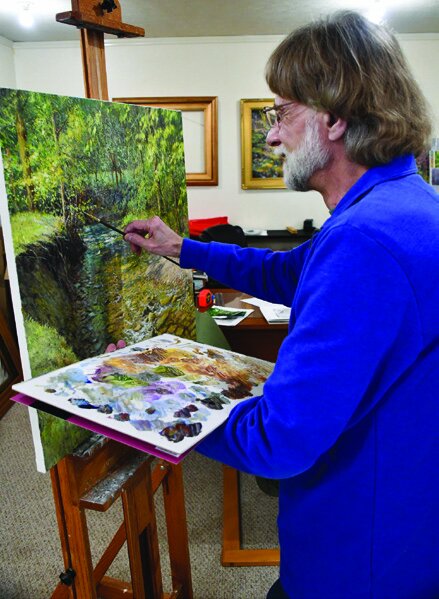
Brown County artist Tim Greatbatch. courtesy photo