~by Jim Eagleman
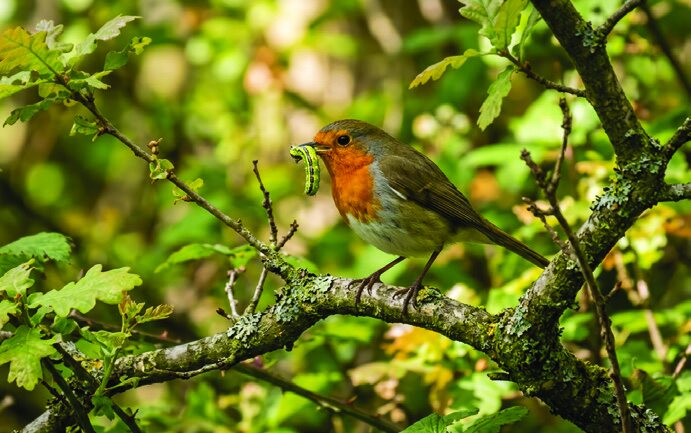
Now that nesting season is over, I can look back on the summer—despite its rain and wind—and count a measure of success among the songbirds on our property. Faithful parents raised numerous young wrens, nuthatches, and chickadees, which are now among the most noticeable birds in the woods.
As summer passed, family bonds gradually loosened and parents offered less food. Our year-round residents will enter the cold season in healthy condition, some on their own and others in groups. Soon, it will be time to fill the winter feeders.
Noise and commotion first signaled that the young were ready to leave the nest. Their constant calls and awkward flights contrasted sharply with the quiet incubation period, when parents slipped in and out to avoid predators. After hatching, the nestlings grew louder with each feeding. Those in open, cup-shaped nests are especially vulnerable, while cavity nesters have a better chance of survival.
It’s the faithful feeding of the young and the tremendous quantities of required food that amazes me. The young of all songbirds must eat often, as Doug Tallamy, author of Nature’s Best Hope claims. “A nestling eats a full meal thirty to forty times a day. That means a parent (or couple) raising five chicks must bring food to the nest about 150 times a day.” They are busy indeed!
Parents usually forage for caterpillars—their nestlings’ primary food—within a defined territory around the nest. For chickadees, Tallamy estimates that this area extends about 160 feet in every direction, covering roughly two acres. To raise their young successfully, birds need abundant food concentrated within this limited range. Much of that food comes from the forest canopy, where layers of branches and leaves support intense summer feeding. Even species that eat nuts and seeds as adults begin life on a protein-rich diet of insects.
I watch openings in the treetops for adult birds, whose quick arrivals and departures are barely visible. They may be collecting caterpillars, but more patient observers have documented the scale of this work. In a five-day study of Wilson’s warblers, the male delivered food 241 times in one day and the female 571 times. The pace remained steady, and each bird often carried several caterpillars per trip. Tallamy notes that even at only one caterpillar per visit, the pair would have supplied 812 a day—or 4,060 during the study.
Our woods are typical of a young hardwood stand, with oak and hickory on the ridges and beech and maple on the slopes. Together, the forest and our native pollinator plantings attract a wide variety of insects that forage throughout every layer and habitat.
Tallamy reports that the lower 48 states contain 2,137 native plant genera, most of which host at least one caterpillar species. Planting natives therefore supports insect communities, especially caterpillars, a keystone food source for forest songbirds.
There is good reason to value oaks. More than 600 species of Hymenoptera—including sawflies and small wasps—depend exclusively on them as host plants. Oaks also support 897 caterpillar species and more moth and butterfly species than any other hardwood.
I have closely watched only one: an inchworm, or “looper,” dangling above my cot on the back deck. Its steady munching hints at the activity throughout the canopy. Caterpillars sustain the food web and are a primary food source for land-nesting birds. As one field-station professor put it, “Connections are what it’s all about.”
In a healthy neighborhood rich with birds, nesting parents need thousands of caterpillars. I wonder whether our native host plants and managed oaks provide enough—and whether native bats can still find the moths that seem scarcer each year. By mowing less and planting a wider variety of species, I hope to improve the outlook.
Woodland sunflowers, Joe-Pye weed, the last wild hydrangea blossoms, and gooseberries clinging to nearly bare branches suggest the close of another season.
This winter, beside a wood stove filled with seasoned oak, I will reflect on what our woods provided for resident birds. Oak leaves nourished caterpillars, which in turn fed bluebirds, wrens, and others. As the cold settles in, I will be watching for them.