~by Mark Blackwell
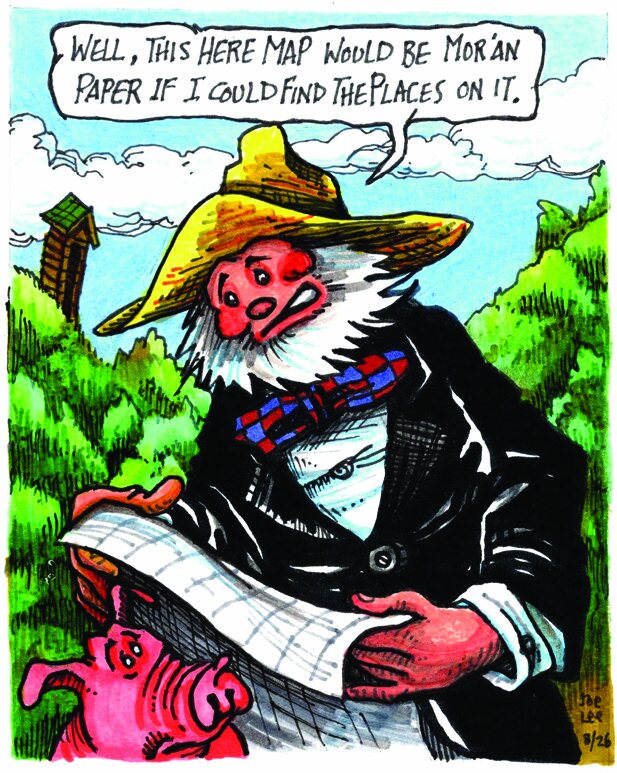
When you look at 19th century maps of this area, you might notice a number of those towns, villages, and communities no longer exist. Some had names like Cleona, Kelp, Ramelton, and Hedgesville. Many shrank into hamlets and some disappeared altogether.
One explanation for the creation of these little communities is that when people were moving from one part of the country to another they usually traveled as a group. Most times there would be small bands made up of several families and/or neighbors that traveled together for safety, mutual aid, and companionship.
The people in these groups developed strong bonds after traveling together for weeks or months, facing dangerous situations, difficulties, and hardship. When they reached their destinations, the parties generally located close to each other. After erecting cabins, planting gardens, and settling in, they built a church or two, and a school. Inevitably, someone would start a general store to sell necessities that could not be produced locally. The beginnings of a village grew into a town, or sometimes dwindled down and disappeared.
I have always been curious about the factors that make a community thrive and those that cause it to dry up and wither away. There are places like Helmsburg, where when driving through it you notice a very nice, stately brick building, a former Masonic Lodge. It stands there as a mute reminder that there was once more to the little village than there is now.
Part of my family can trace its roots back to 1811 in Indiana. They traveled from North Carolina through Kentucky until they landed in what became Lawrence County southwest of Brown County. They traveled with at least three other families and eventually stopped in what was then Indian territory, or close to it. The pioneers described a massacre with one settler dead, and one wounded and captured. No information was available concerning native casualties.
The settlement grew into a village and by 1831 it was incorporated as a town called Leesville. By 1850, a major east-west road, that became a state highway, ran through the middle of town. A few years later it had grown to have an elementary school, a high school, two general stores, three churches, and several livery stables.
But by the 1950s, when I first visited there, the town had devolved into a small village again. It had only schools, a couple of churches, and one remaining general store. Only the churches and a few dwellings exist today. So, what happened to it? Well, several things happened. First, when the railroad came through, it went several miles to the south of the town. Second, the highway was re-routed several miles to the north. Sometime after that came a series of fires and finally, the lack of jobs reduced the population.
Today, it is barely a wide spot on the road with only a historical marker to indicate that it had ever been a thriving community, a place where people set out to build their lives and make something substantial.
That makes me wonder about the places like that in Brown County.
There is Elkinsville, a fairly recent sacrifice. It was started back in 1817 by William Elkins and got a post office in 1860 that lasted until 1941. It also had a school, a general store, and a church. In 1964 it was acquired by “eminent domain” by the U. S. Army Corps of Engineers in order to build Lake Monroe.
It was determined that the town was in the floodway of the lake and required evacuation and demolition of property. However, it turned out that there was some kind of geographical miscalculation and quite a bit of the town could have been preserved.
Hedgesville is an interesting example. In its beginning it claimed to be the first town in Brown County and made a case for being named the county seat. It lost to Jacksonburg in 1836. After that loss, Hedgesville began its demise to the point where today it exists only in rumor and local histories.
And then there is Jacksonburg. The town still exists, but the name was changed. The government, by way of the post office, stepped in to mitigate confusion when it was discovered that there was already another Jacksonburg in Indiana. And that is how Nashville came to be.
The same thing happened to the little village of Georgetown. The post office discovered a town with a previous claim to that name. In 1842 the village was christened Bean Blossom.
Old maps show many other names, including Kelp, which disappeared when the state park was established. There was also Youno, Fruitdale, Buffalo, Mount Liberty, and Cleona. I could not determine how Cleona got its name, but its first postmaster, appointed in 1855, was Sardine Y. Collins.
It is fun to imagine what life was like a hundred or more years ago. Much of the details are lost, but not completely forgotten.