Supporting Language Development Through Interactive Read Alouds
By Christina M. Budde and Christy Tirrell-Corbin

Developmentally appropriate early childhood programs provide children with joyful, play-based learning opportunities focused on the whole child (NAEYC 2022). Critical to this focus is the combination of practices responsive to children’s cultural and linguistic diversity. Multilingual learners, sometimes referred to as dual language learners or English learners, are children who live and study in two or more languages; for example, speaking Spanish at home and learning English in early learning programs and schools. However, many multilingual learners do not receive access to the evidence-based instruction necessary to acquire the skills and knowledge to thrive in educational settings, especially at the level of their non-multilingual peers (Langeloo et al. 2019). As a case in point, only 10 percent of Maryland multilingual learners met the state’s kindergarten readiness expectations in the fall of 2023 (MSDE 2024).
We (the authors) are teacher educators who study literacy, multilingual learners, and early childhood education. Through our work with preschool educators and project-based curricula, we have seen that interactive read alouds can be powerful, accessible avenues for fostering multilingual learners’ oral language, vocabulary, background knowledge, print awareness, and reading comprehension (see “An Integrated Approach to Children’s Learning” below). We have also found that preschool educators often want more concrete guidance on supporting multilingual learners, particularly when they do not share the children’s home languages.
In this article, we offer practical guidance for educators working with preschool-age multilingual learners, paying specific attention to educators who teach primarily in English and may not share children’s home languages. We suggest strategies educators can use before, during, and after a read aloud to scaffold children’s language, content learning, and early literacy development. Although some examples draw on Spanish-English connections, the principles apply across multilingual contexts.
An Integrated Approach to Children’s Learning
Children Discovering Their World curricula, developed by the Center for Early Childhood Education and Intervention at the University of Maryland, are project-based early childhood curricula designed for preschool-age children. While the curricula were developed for all children, multilingual learners benefit from the curricula’s interdisciplinary, project-based approach, which builds on children’s prior knowledge and experiences through hands-on, shared explorations. Interactive read alouds are a central component across projects, and embedded multimodal supports, such as visual vocabulary cards with pictures and labels, help children develop language skills while engaging with rich, content-focused learning.
The curricula originally began in 61 classrooms and are currently implemented in approximately 300 preschool classrooms across Maryland. They were developed through collaboration among researchers, educators, and early childhood partners with funding from the Maryland State Department of Education. They are present in different settings, including Head Start programs, center-based programs, and publicly funded pre-K classrooms. In their feedback, educators shared that the projects elicit children’s active engagement with real-life issues and encourage children’s creativity, problem solving, and individuality.
Multilingual Learners and Early Literacy Development
While research shows that phonological awareness (the ability to recognize and manipulate the sounds in spoken language) and phonics (understanding the relationship between letters and the sounds they represent) are important components of early literacy instruction, young children also need rich opportunities to build oral language, vocabulary, background knowledge, comprehension, and meaningful interactions with texts (Cervetti et al. 2020; Silverman et al. 2020). Reading comprehension involves making meaning from text by connecting ideas from it with prior experiences and knowledge. For multilingual learners, meaning making can occur across languages and is closely connected to oral language experiences and interactions (Kittle et al. 2025).
Research suggests that multilingual learners benefit from explicit instruction for language comprehension as well as print concepts, vocabulary, and foundational literacy skills (Goldenberg 2020; Kittle et al. 2025). Effective approaches leverage their existing linguistic knowledge and incorporate meaningful interactions, discussions, and language use across contexts (NASEM 2017; Budde et al. 2026). In early childhood settings, this includes creating language-rich environments, using multimodal supports such as visuals and gestures, connecting learning experiences across play and inquiry, and providing repeated opportunities for children to engage with vocabulary and concepts in meaningful ways (Finders et al. 2023).
Why Read Alouds Matter for Multilingual Learners
Interactive read alouds can be a powerful tool for building a range of key early literacy skills in young children. Generally, they engage children with rich language, ideas, and print before they can read independently (Swanson et al. 2011; Zhou et al. 2025). Educators craft effective read alouds by introducing new vocabulary and concepts, modeling comprehension strategies, inviting children to talk about texts and share ideas, and drawing attention to how books and print work (Justice & Sofka 2010; Horst et al. 2019; Wright 2019). Educators can use whole group read alouds to build shared knowledge and community, while they may use small group read alouds to focus on certain skills, individualize scaffolding, and extend conversations (Zhou et al. 2025). As a result, children develop oral language, vocabulary, comprehension, background knowledge, and positive dispositions toward literacy (Wright 2019).
Although these read aloud practices build a strong literacy foundation for many children, educators need to consider the assets and needs of multilingual learners. Multilingual learners may face certain hurdles: Too often, important ideas and skills are harder to access when instruction occurs in an unfamiliar language. New vocabulary and language structures can overshadow the content and skills being taught. This is especially important in the preschool years, when children are rapidly developing oral language, vocabulary, background knowledge, and early understanding about how books and print work. For multilingual learners, these skills are developing across languages, making it essential that read alouds provide meaningful access to both language and literacy learning. Therefore, educators must intentionally give supports when planning, implementing, and following up on interactive read alouds with multilingual learners. Some supports are specific to the read aloud while others can be incorporated throughout the day to align with read aloud experiences.
Two especially important approaches are extended study and multimodal strategies. Extended studies involve spending multiple weeks focused on vocabulary, concepts, and inquiry connected to an interesting and relevant topic of study, such as transportation, construction, or the human body (Helm & Katz 2016). Through repeated opportunities across the day, multilingual learners can strengthen both content knowledge and oral language development (Pollard-Durodola et al. 2018; Cervetti et al. 2020; NASEM 2024).
Multimodal strategies, such as gestures, visuals, movement, dramatization, and hands-on materials, can make ideas and language more accessible to multilingual learners. Not only can educators use multimodal strategies to introduce and reinforce new ideas and skills, they can also assess children through multiple modes (McCormick et al. 2023). Importantly, multilingual learners may demonstrate what they know and can do in many ways, including through gestures, movement, drawings, or responses in their home languages and English.
Extended studies and multimodal strategies are not limited to a single part of the read aloud experience. Rather, educators can weave these approaches across the phases of interactive read alouds to help multilingual learners build language, content knowledge, and meaningful connections across contexts.
Enhancing Read Alouds for Multilingual Learners
Given the power of interactive read alouds, educators can intentionally use them to nurture multilingual learners’ language, literacy, and knowledge development. In the sections that follow, we identify practical strategies that educators can implement before, during, and after a read aloud to help each child grow across these areas. These are illustrated in the vignettes below in which a preschool educator applies these strategies to support his multilingual learners.
Before the Read Aloud
What texts should educators choose for the read aloud, and what do they already know about the multilingual learners in their classroom? Teachers should consider the following before the interactive read aloud takes place.
Select Culturally and Linguistically Responsive Texts
Mr. Jensen, whose primary language is English, teaches in a culturally and linguistically diverse preschool classroom that uses a project-based curriculum. Children are currently studying the human body and movement, and he is planning experiences to foster children’s oral language, vocabulary, and conceptual knowledge. As he plans, Mr. Jensen reflects on the questions children have recently asked about how their bodies move, such as “Why does my heart go boom-boom when I run?” and “Why do I have bones in my body?” He also consults his state’s early learning standards. He decides to focus on vocabulary related to body movements and body parts through interactive read alouds, dramatic play, singing and movement activities, and small group conversations.
While looking through available books, Mr. Jensen comes across From Head to Toe, by Eric Carle. This text has many familiar concepts, such as animals, body parts, and various movements, that children can easily connect to their own experiences. This will allow him to build on prior knowledge while introducing new vocabulary and concepts in English and children’s home languages. Furthermore, the book has been published in several different languages. This gives him an idea: In the next classroom newsletter, he asks for families who are interested in recording a read aloud of the book in their home languages to share with the class.
Culturally and linguistically responsive teaching draws upon the unique experiences, perspectives, and assets children bring into learning settings while avoiding deficit perspectives and stereotypes (Gay 2000; Lucas & Villegas 2013). Educators can help multilingual learners by intentionally selecting topics, texts, and instructional materials that reflect children’s lived experiences, interests, and communities while also developing language and literacy skills.
In the vignette above, Mr. Jensen selected a text connected to children’s everyday experiences and ongoing project work. Familiar topics and experiences help multilingual learners focus less on interpreting unfamiliar ideas and more on engaging with new language and skills (Hadaway 2009). Repetitive texts, predictable structures, and engaging illustrations can also promote language and literacy acquisition by providing repeated opportunities to hear and use important vocabulary and language structures.
Educators can also think beyond the text itself. Mr. Jensen invited family members to record themselves, so children could revisit the story in their home languages. This expands the materials available to children: The wider range bolsters comprehension, validates home language use, and reinforces the idea that multilingualism is an asset (Budde et al. 2026).
Become a Language Detective
As Mr. Jensen plans the upcoming read aloud, he considers what he knows about each child’s current language development. Children in his classroom speak Spanish, French, Vietnamese, and English. Most of his multilingual learners are in the beginning stages of English language development and primarily use gestures, pointing, their home languages, and short phrases to communicate ideas and participate in classroom activities. Two children are at an intermediate stage and can follow simple directions in English, express ideas using a growing vocabulary, and participate in longer conversations.
He identifies the key ideas and vocabulary in From Head to Toe that children will need to understand to engage in the read aloud. These include move, body, and parts to discuss how animals and people move different parts of their bodies. Although the word move does not appear directly in the text, Mr. Jensen knows he will frequently use it during discussions and activities. He decides to introduce this word before reading by creating a card that contains the word and an image related to the word’s meaning (see “Vocabulary Card Sample” below).
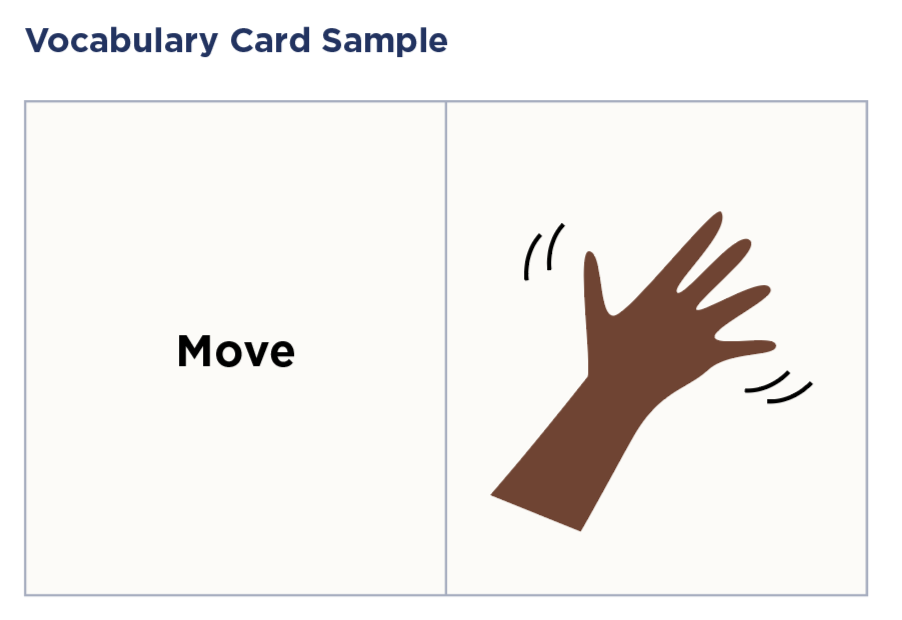
To effectively guide multilingual learners, Mr. Jensen became a language detective. He carefully considered the language demands of the read aloud and compared them to children’s current skills. Then, he selected a few vocabulary words that the multilingual learners in his class would not only hear during the read aloud but would encounter throughout the unit of study. The word move, for example, did not appear directly in the text but would still be essential for understanding and discussion.
As language detectives, educators can consider questions such as
What can children currently understand in English through listening?
Can they follow simple questions and directions in English?
What vocabulary or concepts are already familiar in English or their home languages?
How do children currently communicate their ideas?
Can they respond using gestures, actions, their home languages, short phrases, or complete sentences?
What language demands may require additional support?
Educators can use tools such as state early learning standards, available resources like the WIDA Early Years resources (WIDA 2016), classroom observations, and conversations with families to better understand children’s language and literacy development. Gathering information will help educators gauge the different ways that multilingual learners show what they know and can do, which can depend on the language, context, and type of interactions involved; for example, what they may share during a one-on-one versus whole group interaction. They can also investigate whether children possess background knowledge, in their home languages or in English, that can help them connect with the theme, characters, or concepts in the text.
Educators can then use strategies, such as preview-view-review and cognate instruction, to make language and concepts more accessible (see Budde et al. 2026 for more details). Preview-view-review involves
Previewing important concepts and vocabulary in children’s home languages before instruction
Teaching and interacting with the text primarily in English while using multimodal supports
Reviewing and revisiting ideas in children’s home languages and English after instruction
This process helps children connect prior knowledge and home language experiences to new learning. Multilingual learners do not need to “rediscover” all of the linguistic concepts in each language separately. Instead, they can transfer this knowledge across languages, particularly when educators make these connections explicit (Cummins 2017).
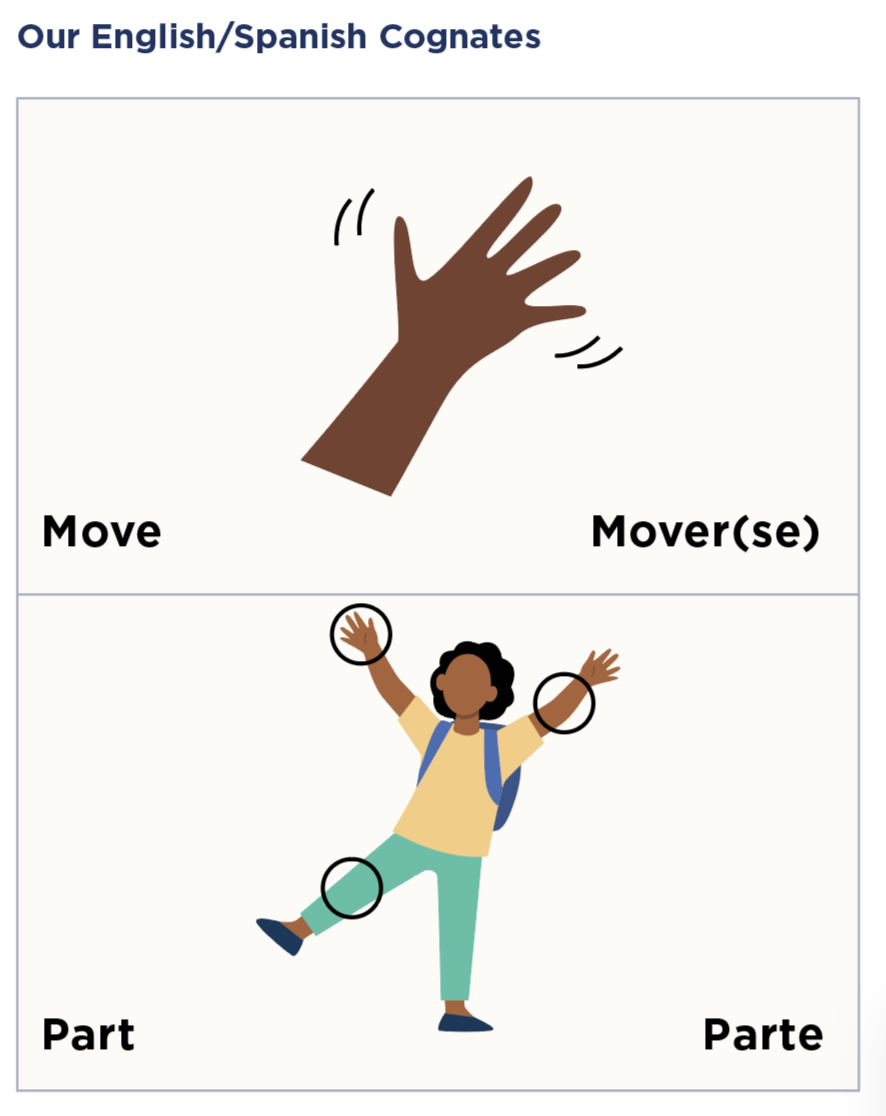
Educators can also reinforce language transfer through cognate instruction (Budde et al. 2026). This helps multilingual learners recognize similarities between words across languages. Cognates are words that share similar meanings and forms across languages, such as the English/Spanish cognates family/familia or animal/animal. Cognate instruction involves
Identifying cognates connected to important vocabulary
Explicitly pointing out similarities between words
Encouraging children to notice connections between their home languages and English
Making cognates explicit not only facilitates multilingual learners’ vocabulary and reading comprehension development but also exposes English-speaking children to new vocabulary and cross-linguistic language awareness (Carlo et al. 2004). Teachers can illustrate this visually by creating a cognate chart (see “Our English/Spanish Cognates” below).
During the Read Aloud
How can teachers facilitate conversation, especially with multilingual learners, as the read aloud occurs? Intentional questioning guides children to interact with the text and demonstrates grammatical structures and vocabulary usage. The read aloud also reveals crucial information about children’s current language skills.
Engage Multilingual Learners in Meaningful Discourse
During the read aloud, Mr. Jensen pauses at certain parts to invite children to respond and engage with the text using gestures, actions, words, their home languages, or short phrases. He introduces the word move while pointing to the illustration of a gorilla on the book’s cover.
He asks, “What animal is this?”
“A gorilla,” Thuy, an intermediate multilingual learner, says.
“Yes, it’s a gorilla,” Mr. Jensen responds. “How can the gorilla move his body?”
Miguel stands up and pounds on his chest, and some of the children respond with smiles and laughter. Mr. Jensen says, “Yes, a gorilla can move his body by pounding on his chest,” while modeling the movement himself. “The gorilla is moving his arms. I can move my body like a gorilla too! What about you?” He invites the class to “move your body like a gorilla.”
As he continues reading, he asks, “What animal do you think we will see next?”
Jaime, who is an emergent multilingual learner, puts his arm to his nose and swings it about. He pauses and is unsure of what to say. Then he says, “Elefante?”
Mr. Jensen nods. “An elephant,” he says. “That’s a good guess. I’ve seen an elephant at the zoo. What about you?”
Jaime says, “Sí. Elephant is big.”
“Yes, elephants are big,” Mr. Jensen says. “Let’s see if there’s an elephant when I turn the page.”
Interactive read alouds foster vocabulary development, enhance conceptual understanding, and encourage active child participation (Cho et al. 2025). As illustrated in Mr. Jensen’s read aloud, multilingual learners benefit from scaffolds that strengthen comprehension and encourage participation. These include questioning techniques tailored to each child’s level of English language proficiency, modeling how to use language to communicate ideas about the text, and assessing children’s understanding throughout the read aloud (Justice & Sofka 2010; Castro et al. 2011; Cho et. al. 2025).
Promote Interactive Learning Through Strategic Questioning
Educators can use a variety of question types to support children’s active involvement, language development, conceptual knowledge, and critical thinking (Ackerman & Tazi 2015). For example, educators might ask
Open-ended questions: “What do you notice about how the animals are moving their bodies?”
Predictive questions: “What animal do you think we will see next?”
Inferential questions: “Why do you think the gorilla thumps its chest?”
Connection questions: “When do you move your head like the penguin in the book?”
As the vignette illustrates, questions can be used not only to check understanding but also to encourage children to talk, move, predict, compare, and make connections between the text and their own experiences.
Finally, educators can pair questions with multimodal supports (gestures, visuals, movement, facial expressions, props) to increase comprehension and participation (Gámez et al. 2017). These supports make abstract language more comprehensible and help multilingual learners connect spoken words to meaning.
Embrace the Role of a Language Model
Educators can model both thinking and language through interactive read alouds. By thinking aloud, answering questions, and sharing observations about a text, educators demonstrate how readers make sense of ideas and use evidence from the story (Rojas et al. 2024). These models help multilingual learners develop critical thinking skills while providing examples of how language can be used to express ideas (Chaparro-Moreno et al. 2017).
For example, after posing a question, Mr. Jensen sometimes paused to model his own thinking before inviting children to respond, such as when he connected his body movements to those of a gorilla’s. By making his thinking visible, Mr. Jensen demonstrated how children can use information from the text and their background knowledge to construct responses.
Educators can also model language by engaging children in conversations, expanding their responses, and showing how to communicate complete ideas. Multilingual learners may respond in their home languages or English or use gestures, such as Jaime’s response to Mr. Jensen’s questions. While educators actively listen, ask follow-up questions, and express genuine interest in responses, they can strategically pause and rephrase. The goal is not to correct every error or interrupt children’s ideas, but rather to provide rich language models that children can hear and use over time. By hearing complete ideas modeled in meaningful and engaging contexts, multilingual learners develop vocabulary, grammar, and expressive language skills while actively participating in conversations.
Observing and Assessing During the Read Aloud
Read alouds also offer valuable opportunities for formative assessment. Educators can observe children’s
Gestures and actions
Responses to questions
Participation in discussions
Use of vocabulary and other targeted skills
Engagement with the ideas in the text
Mr. Jensen recognized Jaime’s action of imitating the elephant as an indicator of comprehension and participation (McCormick et al. 2023). By paying close attention to children’s words and actions, educators can make informed decisions about when to provide additional guidance, revisit important concepts, or extend children’s thinking.
After the Read Aloud
The story may be over, but through intentionally planned follow-up activities, educators can help children cement the language and ideas covered in the read aloud.
Extending Language Use
After the read aloud, Mr. Jensen reflects on ways he can reinforce the vocabulary and concepts taught to the children. He creates a dramatic play center with mirrors, pretend play medical tools, movement cards, and visual labels. He also adds stuffed animals resembling the animals in the book and attaches bandages to their arms, legs, or heads.
Once the center is ready, Mr. Jensen engages with the children as they pretend to be veterinarians.
“Doctor Thuy,” he says, “let’s look at this penguin’s body. Which body part did he hurt?”
She points to one of the penguin’s flippers. “His arm,” she says.
“Yes, he hurt his arm. For penguins, we call this his flipper,” Mr. Jensen confirms. “He has a bandage on his flipper. How can we help him so he can move?”
She thinks for a moment. “We give medicine to help his flipper.”
“Why do you think giving him medicine will work?” Mr. Jensen asks.
“I go to the doctor when I’m sick, and they give me medicine to feel better,” says Thuy. She pretends to give the penguin medicine from a bottle that is labeled with a first-aid sticker.
Language and literacy learning for multilingual learners is strengthened when vocabulary and concepts are revisited across contexts (August et al. 2018). Mr. Jensen incorporated the target words and ideas in a new context. This gave the children opportunities to hear, use, and apply new language in significant and playful ways, helping them connect ideas from the book to their everyday lives.
Educators can reinforce key vocabulary and concepts through
Dramatic play
Song and movement activities
Art and writing
Small group conversations
Hands-on investigations
Connecting to activities shared by and with families
By intentionally revisiting important vocabulary and concepts across experiences, educators create multiple opportunities for multilingual learners to hear, use, and deepen their understanding of new language.
Takeaways for Educators
Preschool educators do not need to speak every language represented in their settings to aid multilingual learners. Through effective read alouds, educators can create rich opportunities for multilingual learners to develop key early language and literacy skills.
As educators reflect on their own practice, they may consider:
How do I currently encourage multilingual learners before, during, and after read alouds?
What changes could I make to the multimodal supports I offer or how I integrate key concepts and words across the day?
In what ways do my instructional materials and texts reflect children’s cultures, languages, and lived experiences?
When interactive read alouds are intentionally designed to support multilingual learners, they can become joyful spaces where children build language, literacy, confidence, and belonging through enriching interactions with texts, ideas, and one another.
About the Authors
Christina M. Budde, PhD, is an associate professor of language and literacy education at the University of Delaware in Newark, Delaware. Her work focuses on literacy and multilingual learner education, teacher preparation, and evidence-based language and literacy instruction. cbudde@udel.edu
Christy Tirrell-Corbin, PhD, is executive director of the Center for Early Childhood Education and Intervention and Dean's Impact professor at the University of Maryland College of Education, College Park, Maryland. Her work centers on early childhood curriculum, inclusive pre-K practices, and professional learning for early childhood educators. ctc@umd.edu
References
Ackerman, D.J., & Z. Tazi. 2015. “Enhancing Young Hispanic Dual Language Learners’ Achievement: Exploring Strategies and Addressing Challenges.” ETS Research Report Series 2015 (1): 1–39. doi.org/10.1002/ets2.12045.
August, D., L. Artzi, C. Barr, & D. Francis. 2018. “The Moderating Influence of Instructional Intensity and Word Type on the Acquisition of Academic Vocabulary in Young English Language Learners.” Reading and Writing 31: 965–89. doi.org/10.1007/s11145-018-9821-1.
Budde, C.M., S.J. Amendum, & J.M. Kittle. 2026. “An Enhanced Science of Reading for Multilingual Learners: The Importance of Leveraging Multilingualism.” The Reading Teacher 79 (5): e70041. doi.org/10.1002/trtr.70041.
Carlo, M.S., D. August, B. Mclaughlin, C.E. Snow, C. Dressler, et al. 2004. “Closing the Gap: Addressing the Vocabulary Needs of English-Language Learners in Bilingual and Mainstream Classrooms.” Reading Research Quarterly 39 (2): 188–215. doi.org/10.1598/RRQ.39.2.3.
Castro, D.C., M.M. Páez, D.K. Dickinson, & E. Frede. 2011. “Promoting Language and Literacy in Young Dual Language Learners: Research, Practice, and Policy.” Child Development Perspectives 5 (1): 15–21. doi.org/10.1111/j.1750-8606.2010.00142.x.
Cervetti, G.N., P.D. Pearson, A.S. Palincsar, P. Afflerbach, P. Kendeou, et al. 2020. “How the Reading for Understanding Initiative’s Research Complicates the Simple View of Reading Invoked in the Science of Reading.” Reading Research Quarterly 55 (S1): S161–72. doi.org/10.1002/rrq.343.
Chaparro-Moreno, L.J., F. Reali, & C. Maldonado-Carreño. 2017. “Wordless Picture Books Boost Preschoolers’ Language Production During Shared Reading.” Early Childhood Research Quarterly 40: 52–62. doi.org/10.1016/j.ecresq.2017.03.001.
Cho, H., T. Christ, & M.M. Chiu. 2025. “Multilingual Learners’ Vocabulary Talk in Read-Aloud Discussions.” Journal of Research in Childhood Education: 1–27. doi.org/10.1080/02568543.2025.2587619.
Cummins, J. 2017. “Teaching for Transfer in Multilingual School Contexts.” In Bilingual and Multilingual Education, eds. O. Garcia, A.M.Y. Lin, & S. May. 3rd ed. Springer Cham.
Finders, J., E. Wilson, & R. Duncan. 2023. “Early Childhood Education Language Environments: Considerations for Research and Practice.” Frontiers in Psychology 14: 1202819. doi.org/10.3389/fpsyg.2023.1202819.
Gámez, P.B., S.R. Neugebauer, M.D. Coyne, D.B. McCoach, & S. Ware. 2017. “Linguistic and Social Cues for Vocabulary Learning in Dual Language Learners and Their English-Only Peers.” Early Childhood Research Quarterly 40: 25–37. doi.org/10.1016/j.ecresq.2017.01.003.
Gay, G. 2000. Culturally Responsive Teaching: Theory, Research, and Practice. Teachers College Press.
Goldenberg, C. 2020. “Reading Wars, Reading Science, and English Learners.” Reading Research Quarterly 55 (S1): S131–44. doi.org/10.1002/rrq.340.
Hadaway, N.L. 2009. “A Narrow Bridge to Academic Reading.” Educational Leadership 66 (7): 38–41. ascd.org/el/articles/a-narrow-bridge-to-academic-reading.
Helm, J., & L. Katz. 2016. Young Investigators: The Project Approach in the Early Years. 3rd ed. Teachers College Press.
Horst, K.M., L.H. Stewart, & S. True. 2019. “Joyful Learning with Stories: Making the Most of Read Alouds.” Young Children 74 (1): 14–21.
Justice, L.M., & A.E. Sofka. 2010. Engaging Children with Print: Building Early Literacy Skills Through Read-Alouds. The Guilford Press.
Kittle, J.M., S.J. Amendum, & C.M. Budde. 2025. “What Does Research Say About the Science of Reading for K-5 Multilingual Learners? A Systematic Review of Systematic Reviews.” Educational Psychology Review 36 (4): 108. doi.org/10.1007/s10648-024-09942-6.
Langeloo, A., M.M. Lara, M.I. Deunk, N.F. Klitzing, & J.W. Strijbos. 2019. “A Systematic Review of Teacher-Child Interactions with Multilingual Young Children.” Review of Educational Research 89 (4): 536–68. doi.org/10.3102/00346543198556119.
Lucas, T., & A.M. Villegas. 2013. “Preparing Linguistically Responsive Teachers: Laying the Foundation in Preservice Teacher Education.” Theory Into Practice 52 (2): 98–109. doi.org/10.1080/00405841.2013.770327.
MSDE (Maryland State Department of Education). 2024. Readiness Matters: 2023–2024 Kindergarten Readiness Assessment Report. Maryland State Department of Education. earlychildhood.marylandpublicschools.org/sites/default/files/files/Readiness%20Matters%20KRA%20Report%202023-2024%20(1).pdf.
McCormick, K.I., C. Uliassi, K. Barber, & K. Wieczorek. 2023. “Creating Multimodal Experiences to Engage All Students in Early Elementary Classrooms.” Young Children 78 (3): 24–32.
NAEYC. 2022. Developmentally Appropriate Practice in Early Childhood Programs Serving Children from Birth Through Age 8. 4th ed. NAEYC.
NASEM (National Academies of Sciences, Engineering, and Medicine). 2017. Promoting the Educational Success of Children and Youth Learning English: Promising Futures. The National Academies Press.
NASEM (National Academies of Sciences, Engineering, and Medicine). 2024. A New Vision for High-Quality Preschool Curriculum. The National Academies Press. doi.org/10.17226/27429.
Pollard-Durodola, S.D., J.E. Gonzalez, L. Saenz, N. Resendez, O. Kwok, et al. 2018. “The Effects of Content-Enriched Shared Book Reading Versus Vocabulary-Only Discussions on the Vocabulary Outcomes of Preschool Dual Language Learners.” Early Education and Development 29 (2): 245–65. doi.org/10.1080/10409289.2017.1393738.
Rojas, N.M., G. Melzi, & A. Schick. 2024. “Teacher’s Use of English and Spanish Interactive Strategies During Wordless Shared Book Reading: Relations to Emergent Bilingual Children’s Responses.” Education Sciences 14 (10): 1096. doi.org/10.3390/educsci14101096.
Silverman, R.D., E. Johnson, K. Keane, & S. Khanna. 2020. “Beyond Decoding: A Meta-Analysis of the Effects of Language Comprehension Interventions on K–5 Students’ Language and Literacy Outcomes.” Reading Research Quarterly 55 (S1): S207–33. doi.org/10.1002/rrq.346.
Swanson, E., S. Vaughn, J. Wanzek, Y. Petscher, J. Heckert, et al. 2011. “A Synthesis of Read-Aloud Interventions on Early Reading Outcomes Among Preschool Through Third Graders at Risk for Reading Difficulties.” Journal of Learning Disabilities 44 (3): 258–75. doi.org/10.1177/0022219410378444.
WIDA. 2016. Can Do Descriptors: Early Years. Board of Regents of the University of Wisconsin System. wida.wisc.edu/sites/default/files/resource/CanDo-Descriptors-Early-Years.pdf.
Wright, T.S. 2019. “Reading to Learn from the Start: The Power of Interactive Read-Alouds.” American Educator 42 (4): 4–8, 40. files.eric.ed.gov/fulltext/EJ1200226.pdf.
Zhou, T., E. Djonov, & A. Chik. 2025. “Shared Reading of Picturebooks for Supporting Preschool Children’s Multilingual Learning: A Scoping Review.” International Journal of Educational Research 133:102716. doi.org/10.1016/j.ijer.2025.102716.
Photograph: © Getty Images. Copyright © 2026 by the National Association for the Education of Young Children. See permissions and reprints online at NAEYC.org/resources/permissions.