Strategies for Connecting with Families and Communities
By Socorro García, Karen L. B. Burgard, and Melissa M. Jozwiak

Authors’ note: Families within public school systems are often presented with limited options to identify their ethnic or cultural heritages. In this article, families refer to themselves as Hispanic or Non-Hispanic because the terms Latino/a and Latinx were not available when they responded to a governing agency. We recognize the colonizing history of the term Hispanic and that discussion surrounding Hispanic, Latino/a, and Latinx continues to evolve. While NAEYC style is to use Latino/a, when we refer to families, we use the term Latinx as a demonstration of inclusivity.
A strengths-based early childhood curriculum that incorporates play-based practices while drawing on children’s cultures and communities is essential for the effective education and care of young children (NAEYC 2020; NASEM 2024). Educators must immerse themselves in the communities they serve so they can create playful learning experiences that build on children’s cultural and linguistic assets while working toward specific learning goals (Allen & Rodriguez 2026). This requires establishing reciprocal relationships with families and community members to understand their perceptions about play and to communicate why it is important in early education (Zosh et al. 2022).
Intentional educators draw upon children’s and families’ funds of knowledge to create playful learning opportunities that reflect children’s social and cultural knowledge, skills, and experiences (Yosso 2005; Moll et al. 2006; Salinas-Gonzalez et al. 2018). To do this, they must continually ask
What are children’s and families’ experiences?
What are they talking about?
What is happening in their communities?
These questions can guide educators as they create learning opportunities within and beyond an early childhood setting. This approach also supports equity: It recognizes each child’s unique strengths, and it values the community as a context for learning (NAEYC 2019).
In 2021, Texas A&M University–San Antonio received a multimillion-dollar, five-year grant from the US Department of Education to provide culturally relevant arts education experiences for students, prekindergarten through grade 5, and their families. The grant supported more than 800 educators throughout the city to receive arts integration professional development and more than three dozen arts experiences for families to engage in together.
We (the authors) were tasked with designing and implementing culturally relevant, arts-based family engagement experiences. As part of this work, we partnered with a local Title I elementary school. At the time, nearly 90 percent of the school’s student body identified as Hispanic, and 94 percent came from homes designated by the state as economically disadvantaged. We wanted to introduce community-informed, guided play strategies to this school that purposefully integrated families’ cultures and identities as children developed oral language skills in both Spanish and English.
In this article, we explain the importance of community and culture in children’s development. We describe how we decided to focus on San Antonio’s rich mariachi history to honor children’s cultures and contexts through family-focused, guided play activities. We then offer ways that other early childhood administrators and educators who work with children from age 3 through the primary grades can engage and reflect their larger communities in their play-based curricula.
Melding Culture, Arts, and Play
Every community has shared knowledge, experiences, and interests that are passed from one generation to another and that help to shape a child’s development (Moll et al. 2006). Often, this is done through activities like storytelling, creating and viewing artwork, participating in music and movement, and other language- and arts-based experiences (Korn 1998; Otto 2014). Children bring these experiences with them to early learning programs and schools, where they use their social and cultural knowledge to make sense of new ideas and skills (Yosso 2005).
An impactful early childhood curriculum builds on children’s cultural and community assets to address meaningful goals in an integrated way across domains and content areas (NAEYC 2020; NASEM 2024). For example, children can use the arts to develop language and communication skills as they tell stories, entertain themselves and others, and showcase their individuality. The personal, cultural, and linguistic expression afforded through arts activities offers a purposeful pathway for children to connect their learning with their lived experiences (Purnell et al. 2007; Carney et al. 2016).
Adults can facilitate when and how children use play to connect learning with their experiences; specifically, through guided play. During these activities and explorations, children have the agency to interact with each other and with thoughtfully curated materials while working toward specific learning goals (Zosh et al. 2022). When done well, guided play has been shown to support the development of the whole child, including in the cognitive, physical, social, and emotional domains (Zosh et al. 2017; Jensen et al. 2019; Stipek & Johnson 2020; Hall & McCormick 2022).
However, teachers must consider children’s individuality and contexts (NAEYC 2020) when implementing guided play. Children actively engage with and make sense of material when their cultures, languages, traditions, and communities are valued and reflected in what they are learning (Ladson-Billings 1995a, 1995b, 2014; Gay 2002). This strengths-based approach connects to children’s lived experiences and supports them in “sustaining the cultural and linguistic competence of their communities” (Paris 2012, 95).
Mariachi as a Community Connection
Families and communities play a central role in children’s learning and development. As stressed in NAEYC’s “Early Childhood Program Standards” position statement, both early childhood educators and administrators must create welcoming environments where families are respected and encouraged to collaborate in their children’s educational growth (NAEYC 2025). One way to do this is to plan family-focused, guided play activities that involve the community.
As part of our project, the elementary school we were working with asked us to create a culturally relevant arts activity that families and children could participate in during monthly family engagement meetings. Partnering with the school’s family liaison, Ms. Hernández, we worked to re-envision these meetings as cafecitos, or community-bonding experiences rooted in culture and mutual understanding. Cafecitos are used in the Latinx community as a time to drink coffee, socialize, engage in conversation, learn from one another, and build connections.
We decided to use one of the cafecitos to build art, storytelling, and music activities around mariachi. Every year, San Antonio hosts the Mariachi Extravaganza, a 30-year-old music festival that celebrates the culture and history of Latin music. Mariachi bands from the United States and Mexico participate in a three-day competition that showcases their talents. The extravaganza also features performances by professional mariachi solo artists and award-winning bands. The school we worked with invited Jonathan Palomar, a renowned professional mariachi performer and one of the extravaganza’s headliners, to visit and teach children about mariachi music. The entire school campus gathered together and sang along as he performed “Cielito Lindo,” a symbol of Latinx culture that is passed from generation to generation.
To extend children’s excitement around mariachi, we invited families to join their children in a guided play activity that focused on building students’ oral language skills. In response to flyers and social media posts, 27 prekindergarten-to-second-grade children and their families attended our mariachi-themed cafecito.
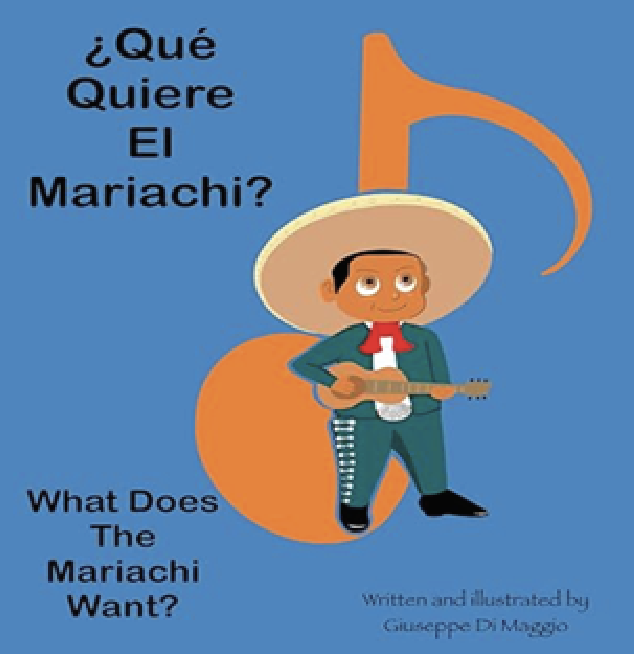
Ms. Hernández begins reading Qué Quiere El Mariachi? What Does the Mariachi Want?, by Giuseppe Di Maggio. This bilingual picture book, which aligns with families’ home language of Spanish, features a mariachi who asks questions about the families’ daily lives, such as “Do you want to play?” The simple yes or no questions help to build vocabulary and comprehension in both English and Spanish.
After the read aloud, Ms. Hernández asks the children and their families to create a mariachi puppet from assembled materials. These include a paper lunch bag for the puppet’s body, black construction paper for a mustache or beard, various squares of colored paper to represent sarapes and sombreros, and brown construction paper to represent musical instruments.
Families and children enthusiastically begin the activity, with children measuring construction-paper mustaches and beards on their faces before gluing them down and pretending to string their instruments before placing them on their puppets. Families begin to position paper sombreros on their heads, asking children for their approval and talking about puppet making.

When the families and children are done, Ms. Hernández plays “Cielito Lindo,” projecting the lyrics on a big screen so that everyone can sing along. As the song ends, she offers time for the children and their families to play with their puppets, retell the story of Qué Quiere El Mariachi?, and sing together. Some families decide to share more mariachi songs while others tell stories about their experiences with mariachis.
Language is foundational to the child, home, and community; it cannot be separated from these contexts as children grow and learn in school (García & García 2012). It is through language that “we represent the world and learn about the world” (Otto 2014, 3). Oral language can develop through many engaging, playful activities in early childhood settings, including retelling stories, singing, and—in this case—puppet making (Mujahidah et al. 2021).
When planning this guided play, family-focused activity, we began by thinking about the members of our school community. To ensure families’ involvement, we had to know who they were and what they enjoyed. Based on our knowledge of the community, conversations we had with the families, and talking with Ms. Hernández, we knew how closely the Mariachi Extravaganza connected to the elementary school’s Latinx population. Given the relationship we had built with the school community over the grant’s first two years, we were confident that families would make personal connections to the activity.
Both we and Ms. Hernández also had to consider children’s interests, experiences, and abilities before implementing this cafecito. As we created a relaxed space where children and families could create, we worked to plan specific activities connected to oral language skills (read alouds, singing, time for family conversation). We also developed questions and prompts (“Ask your family about the mariachi music they like”) to encourage children to express their individuality as they worked. Finally, we provided multiple opportunities for families to engage in the guided play activity. Some families decided to share more mariachi songs with their children while others opted to tell their children a story about a mariachi experience.
As cafecitos continued at this elementary school as part of the grant, they increasingly included activities around topics suggested or requested by families, such as cultural traditions like Las Posadas and Día de los Muertos. This further demonstrated the community’s trust that these experiences would be meaningful and reflect what was important to them.
Implications for Practice
While curriculum is at its core the transmission of knowledge and skills (Egan 1978), we argue for a more inclusive and expansive definition. Curriculum can be found in family learning, where traditions and cultural connections are passed across the generations of family and community members (Yosso 2005; Esteban-Guitart & Moll 2014; Stephan 2021). Early childhood educators must center children’s cultures and communities as they plan learning experiences, which include guided play (Arreguín-Anderson et al. 2018; NAEYC 2020).
While we used the arts as the entry point to our culturally connected, guided play activity, educators can use any content area that offers authentic links with their communities. To begin, we encourage them to reflect on the following:
What is happening in children’s and families’ communities? Educators can discover what is relevant to the families they serve by exploring neighborhood events and listening to what families are talking about.
How can educators use what they learn to plan activities and spark interest in them? Educators can ask families about their curiosities and experiences related to a topic and refine instructional materials and activities based on their feedback.
How can the community-connected, guided play activity be linked to content learning? We suggest educators begin by noticing the language and ideas used by families and communities, then connecting these to learning goals and experiences.
What options are available to encourage families to engage with the playful experience? For example, when working with families in the school setting, educators can begin by making them feel comfortable in this environment and providing various ways (or modalities) in which families can participate in play-based activities.
Funding Acknowledgment
Partial funding for this project was provided by the CULTIVAR (Communities Uplifting Learners Through Imagination and Vibrant Artistic Reflections) grant project awarded to Texas A&M University–San Antonio through the Assistance for Arts Education and the US Department of Education. Grant Award Number: S351A210030–22. Any opinions, findings, or conclusions expressed in this article are those of the authors and do not necessarily reflect the views of Texas A&M University–San Antonio or the US Department of Education.
About the Authors
Socorro García, PhD, is an assistant professor at Texas A&M University–San Antonio. She is the co-principal investigator on a federal grant and oversees the parental practices and family engagement on the project. socorro.garcia@tamusa.edu
Karen L. B. Burgard, PhD, is an associate professor in the Department of Curriculum and Instruction at Texas A&M University–San Antonio. kburgard@tamusa.edu
Melissa M. Jozwiak, PhD, is a professor of early childhood at Texas A&M University–San Antonio in San Antonio, Texas. mjozwiak@tamusa.edu
References
Allen, R., & D.S. Rodriguez. 2026. Becoming a Culturally Responsive Teacher: Sustaining the Cultures of Young Children. NAEYC.
Arreguín-Anderson, M.G., I. Salinas-Gonzalez, & I. Alanis. 2018. “Translingual Play That Promotes Cultural Connections, Invention, and Regulation: A LatCrit Perspective.” International Multilingual Research Journal 12 (4): 273–87. doi.org/10.1080/19313152.2018.1470434.
Carney, C.L., G.J. Weltsek, M.L. Hall, & G. Brinn. 2016. “Arts Infusion and Literacy Achievement Within Underserved Communities: A Matter of Equity.” Arts Education Policy Review 117 (4): 230–43. doi.org/10.1080/10632913.2016.1213123.
Egan, K. 1978. “What Is Curriculum?” Curriculum Inquiry 8 (1): 65–72.
Esteban-Guitart, M., & L.C. Moll. 2014. “Funds of Identity: A New Concept Based on the Funds of Knowledge Approach.” Culture & Psychology 20 (1): 31–48. doi.org/10.1177/1354067X13515934.
García, E.E., & E.H. García. 2012. Understanding the Language Development and Early Education of Hispanic Children. Teachers College Press.
Gay, G. 2002. “Preparing for Culturally Responsive Teaching.” Journal of Teacher Education 53 (2): 106–16. doi.org/10.1177/0022487102053002003.
Hall, J.A., & K.I. McCormick. 2022. “ ‘My Cars Don’t Drive Themselves’: Preschoolers’ Guided Play Experiences with Button-Operated Robots.” TechTrends 66 (3): 510–26. doi.org/10.1007/s11528-022-00727-8.
Jensen, H., A. Pyle, B. Alaca, & E. Fesseha. 2019. “Playing with a Goal in Mind: Exploring the Enactment of Guided Play in Canadian and South African Early Years Classrooms.” Early Years 41 (5): 491–505. doi.org/10.1080/09575146.2019.1619670.
Korn, C. 1998. “How Young Children Make Sense of Their Life Stories.” Early Childhood Education Journal 25 (4): 223–28. doi.org/10.1023/A:1025638619861.
Ladson-Billings, G. 1995a. “But That’s Just Good Teaching! The Case for Culturally Relevant Pedagogy.” Theory into Practice 34 (3): 159–65. doi.org/10.1080/00405849509543675.
Ladson-Billings, G. 1995b. “Toward a Theory of Culturally Relevant Pedagogy.” American Educational Research Journal 32 (3): 465–91. doi.org/10.3102/00028312032003465.
Ladson-Billings, G. 2014. “Culturally Relevant Pedagogy 2.0: a.k.a. the Remix.” Harvard Educational Review 84 (1): 74–84. doi.org/10.17763/haer.84.1.p2rj131485484751.
Moll, L., C. Amanti, D. Neff, & N. Gonzalez. 2006. “Funds of Knowledge for Teaching: Using a Qualitative Approach to Connect Homes and Classrooms.” In Funds of Knowledge: Theorizing Practices in Households, Communities, and Classrooms, eds. N. Gonzalez, L.C. Moll, & C. Amanti. Routledge.
Mujahidah, N., E. Damayanti, & A. Afiif. 2021.“The Role of Storytelling Methods Using Hand Puppets in Early Children’s Language Development.” Child Education Journal 3 (2): 78–91. doi.org/10.33086/cej.v3i2.2129.
NAEYC. 2019. “Advancing Equity in Early Childhood Education.” Position statement. NAEYC. naeyc.org/resources/position-statements/equity.
NAEYC. 2020. “Developmentally Appropriate Practice.” Position statement. NAEYC. naeyc.org/resources/position-statements/dap/contents.
NAEYC. 2025. “Early Childhood Program Standards.” Position statement. NAEYC. naeyc.org/resources/position-statements/early-childhood-program-standards.
NASEM (National Academies of Sciences, Engineering, and Medicine). 2024. A New Vision for High-Quality Preschool Curriculum. National Academies Press. doi.org/10.17226/27429.
Otto, B. 2014. Language Development in Early Childhood Education. Pearson.
Paris, D. 2012. “Culturally Sustaining Pedagogy: A Needed Change in Stance, Terminology, and Practice.” Educational Researcher 41 (3): 93–97. doi.org/10.3102/0013189X12441244.
Purnell, P.G., P. Ali, N. Begum, & M. Carter. 2007. “Windows, Bridges, and Mirrors: Building Culturally Responsive Early Childhood Classrooms Through the Integration of Literacy and the Arts.” Early Childhood Education Journal 34 (6): 419–24. doi.org/10.1007/s10643-007-0159-6.
Salinas-Gonzalez, I, M.G. Arreguín-Anderson, & I. Alanís. 2018. “Supporting Language: Culturally Rich Dramatic Play.” Teaching Young Children 11 (2): 4–6.
Stephan, A. 2021. “Intergenerational Learning in the Family as an Informal Learning Process: A Review of the Literature.” Journal of Intergenerational Relationships 19 (4): 441–58. doi.org/10.1080/15350770.2020.1817830.
Stipek, D., & N.C. Johnson. 2020. “Developmentally Appropriate Practice in Early Childhood Education Redefined: The Case of Math.” In Advancing Knowledge and Building Capacity for Early Childhood Research, eds. S. Ryan, M.E. Graue, V.I. Gadsden, & F.J. Levine. American Educational Research Association.
Yosso, T.J. 2005. “Whose Culture Has Capital? A Critical Race Theory Discussion of Community Cultural Wealth.” Race Ethnicity and Education 8 (1): 69–91. doi.org/10.1080/1361332052000341006.
Zosh, J.M., E.J. Hopkins, H. Jensen, C. Liu, D. Neale, et al. 2017. Learning Through Play: A Review of the Evidence. The LEGO Foundation. hcms.learningthroughplay.com/media/wmtlmbe0/learning-through-play_web.pdf.
Zosh, J.M., C. Gaudreau, R.M. Golinkoff, & K. Hirsh-Pasek. 2022. “The Power of Playful Learning in the Early Childhood Setting.” In Developmentally Appropriate Practice in Early Childhood Programs Serving Children from Birth Through Age 8. 4th ed. NAEYC.
Photographs: courtesy of authors and the CULTIVAR grant. Copyright © 2026 by the National Association for the Education of Young Children. See permissions and reprints online at NAEYC.org/resources/permissions.