“The Most Comfortable of Uncomfortable Spaces”
By Pamela Thompson, Sarah Elahi, Lisa Goddard, Megan Shahnooshi, and Megina Baker

Co-Constructing a Toddler Curriculum Through Equitable Practitioner Collaboration
Authors’ Note
The NAEYC style guide and other publishers encourage the use of capital letters when referring to Black and white racialized groups. In order to decenter whiteness, we choose to lowercase white while capitalizing Black and People of Color (Howell et al. 2019).
The field of curriculum development has long been a white-dominated space, with much of the curricula used in schools developed far from the schools themselves (Hester 2018). Research shows that this often results in early childhood educators, overwhelmingly women who are Black, Indigenous, and People of Color (BIPOC), suffering from feelings of disempowerment and believing their knowledge and expertise are not valued by society. They report poor mental health as a result (Otten et al. 2019).
We (the authors) represent a diverse, predominantly BIPOC group of early childhood educators, directors, and coaches who work with Neighborhood Villages, a nonprofit organization that supports 13 early childhood education centers in Boston, Massachusetts. In 2021, we were collectively dissatisfied with the commercially available curricular offerings for our toddler classrooms, which serve children ages 15 months to 3 years from historically marginalized groups. We found a scarcity of curricula that view infants and toddlers as competent, capable, and creative and that are grounded in anti-bias and culturally responsive practices. Many new teachers in our network were turning to Pinterest (a social media site for categorizing and sharing images) for quick activities to do with their toddlers—far from the rich, sustained experiences young children deserve. As one of our group members articulated, “We can do better for our children.” In response, we envisioned developing our own toddler curriculum. (See “A Curriculum Developed by Early Childhood Practitioners” below for more information.)
After receiving a grant from the LEGO Foundation, we hired a curriculum fellow to organize and support this work. The curriculum fellow conducted a literature review on currently available curricula for very young children and successful pedagogical approaches for teaching toddlers, oversaw coordination of working group participants, coordinated the distillation of ideas and feedback, and led the writing of materials. As we moved forward, we documented the process of co-constructing our curriculum over the course of the 2022–2023 school year.
In this article, we take a retrospective look across our documentation to explore the question: What happens when a group of early childhood practitioners engages in sustained, in-depth collaboration to develop a curriculum for toddlers? By documenting the process, we hoped to highlight the powerful potential of a community-driven, inclusive approach to curriculum development for others to apply in their own settings.
A Curriculum Developed by Early Childhood Practitioners
The published result of this process is the free and open-source Learning Through Exploration: A Play-Based Toddler Curriculum. This developmentally appropriate curriculum provides educators, children, and families with playful, engaging, and joyful learning experiences tailored to children ages 15 to 33 months. The curriculum offers a play-based, community-developed, anti-bias, and Reggio-inspired approach to teaching and learning, combining guidance on observation, documentation, and emergent curriculum with support for educators, family engagement strategies, and children’s literature recommendations. It is organized into five in-depth Explorations (All About Us, Our Bodies, How Things Move, Nature All Around Us, and Playing with Materials). Each is centered around a set of big questions that children and educators explore together through open-ended learning experiences. The curriculum documents are designed to be flexible and responsive to the needs and interests of children; Explorations do not need to be done in any specific order. Visit neighborhoodvillages.org/nv-exploration for more information.
Theoretical Framework
Our work is grounded in a theoretical orientation that practitioners can and should be seen as knowledgeable, capable producers of knowledge for the education field (Cochran-Smith & Lytle 1999, 2009). Practitioners such as teachers, school-based administrators, and educational coaches rarely participate as leaders in research processes; rather, they are most frequently seen as subjects or participants in research conducted by academics (Cochran-Smith & Lytle 2009). We are strongly committed to engaging in research as practitioners, studying our own practice, and sharing this knowledge with others to contribute to the wider educational research conversation, thus contributing to the teacher research community (Perry et al. 2012; Escamilla & Meier 2018; Henderson 2025).
We are also committed to an anti-bias education stance (Derman-Sparks & Edwards, with Goins 2020) and to equity as well as elevating the voices of marginalized populations. This means actively examining and challenging the systems, materials, and practices within early childhood settings that may perpetuate inequality or exclude the lived experiences of educators, children, and families from underrepresented communities.
Finally, we believe that playful learning is a powerful vehicle for education at all levels, for young children and older learners alike (Liu et al. 2017; Mardell et al. 2023). We draw on the definition of playful learning offered by Mardell and colleagues (2023), which involves learners leading their own learning, exploring the unknown, and finding joy in the process. In the context of curriculum development, the “unknown” is the development of a novel curriculum; leading learning could happen when collaborators generate ideas together; and joy might be evoked by taking pleasure in the process, feeling connected, and having one’s ideas valued. We aimed for this inclusive and iterative process to sustain a focus on the presence of educators’ voices and address real expressed needs of the community.
Limitations of Available Curricula for Toddlers
Our literature review found a paucity of curriculum resources that included the voices of educators and families. In addition, there was limited research on best practices for infants and toddlers in the areas of anti-bias and culturally responsive teaching (Bauer et al. 2006; Horm et al. 2012; Horm et al. 2019). Existing resources also tended to be rigid, with little room for educators to co-create learning experiences or enjoy flexibility adapted to the unique needs of their classroom communities (Ebbeck et al. 2018; Harmon & Viruru 2018).
Methods of Inquiry
This practitioner inquiry, conducted over the course of the 2022–2023 school year, investigated what happens when early childhood practitioners engage in sustained, in-depth collaboration to develop a toddler curriculum. Our goal was to write a comprehensive, developmentally appropriate, play-based curriculum for toddlers (Kelly 2018; Hammond 2019; NAEYC 2022).
In alignment with our commitment to an anti-bias education stance, we chose to work within a participatory design framework (Reason & Bradbury 2001; Noffke & Somekh 2009), taking a collaborative approach to meeting the needs of the educators and the children and families that they serve. We formed two working groups: The Educator Working Group and the Critical Friends Working Group. The Educator Working Group consisted of educators, center directors, coaches, and family members of children enrolled in the centers. The majority of this working group, including the authors, identify as People of Color. This group generated ideas for each of the Explorations (curriculum units) and children’s literature and provided feedback on all aspects of the written documents, document layout, and user readability. The Critical Friends Working Group consisted of curriculum experts, toddler educators, early childhood education professors, and subject matter experts in early childhood education. This group provided feedback on curriculum documents through a critical lens, ensuring alignment with developmentally appropriate practices, current research, and anti-bias principles. All working group members received compensation for their time and expertise. (See “Working Group Members” below for a list of the roles of individuals in each working group.)
Practitioners in the working groups co-constructed the curriculum at all stages of the process, including
Agreeing on shared values to guide the curriculum
Conceptualizing curriculum structures
Brainstorming individual curriculum Explorations
Providing iterative feedback on specific curriculum materials
Frequently, this type of project is guided by a for-profit curriculum developer. We wanted to see what would happen when we undertook the process ourselves and had ownership of the entire experience.
In our research to better understand and reflect on the process, we drew on practitioner inquiry and teacher research practices articulated by Perry and colleagues (2012) as well as Cochran-Smith and Lytle (2009). We began by collaboratively agreeing on a research question, gathering documentation over time, and analyzing the data. Our data consisted of documentation collected from our working groups over the course of the curriculum development process. We used a thematic qualitative approach for our data analysis, which involved methodically reviewing data sources, coding to sort chunks of data by topic, and then identifying and documenting themes across the data (Braun & Clarke 2006).
Working Group Members
To develop a toddler curriculum, we formed two working groups: The Educator Working Group and the Critical Friends Working Group.
Members of the Educator Working Group were representatives from
East Boston Social Centers (2 toddler educators and 1 administrator)
Epiphany Early Learning Center (1 administrator and 1 toddler parent)
Ellis Early Learning (3 administrators)
Horizons for Homeless Children (1 toddler educator and 1 administrator)
Nurtury Early Education (1 early childhood coach and 1 administrator)
Neighborhood Villages Teaching and Learning Team (6 coaches/curriculum writers)
Members of the Critical Friends Working Group were
Early childhood education professors
Family child care providers
Early childhood educators (center-based)
Subject matter experts in play in early childhood, anti-bias education, early childhood research, early childhood curriculum development, the Reggio Emilia approach, and trauma-informed care
Data Sources and Analysis
The focus of our inquiry is not the written curriculum itself, but rather documentation from the process of co-constructing the curriculum in working groups. We aim to share materials and actions for creating or modifying curricula that others can try in their own contexts. Our data sources included detailed meeting notes, video and audio recordings, and digital working group documents (collaborative workboards, draft curriculum documents, and shared documents) from 18 sessions with the Educator Working Group and nine meetings with the Critical Friends Working Group. Each session lasted 90 minutes and was documented by a member of the working group. To offer maximum flexibility for practitioners, meetings were conducted via Zoom, with in-person gatherings at the launch and conclusion of the project.
We (the authors) were all collaborators on the writing of the curriculum and conducted the data analysis together. We employed an iterative open-coding approach (Saldaña 2012), which involves inductively generating and refining codes through repeated, systematic examination of the data. We collaborated to track emerging codes and data examples as a group. After each round of coding, we met to confer about the emerging codes. Once all data had been reviewed and discussed, we met again to organize the codes into themes.
Findings
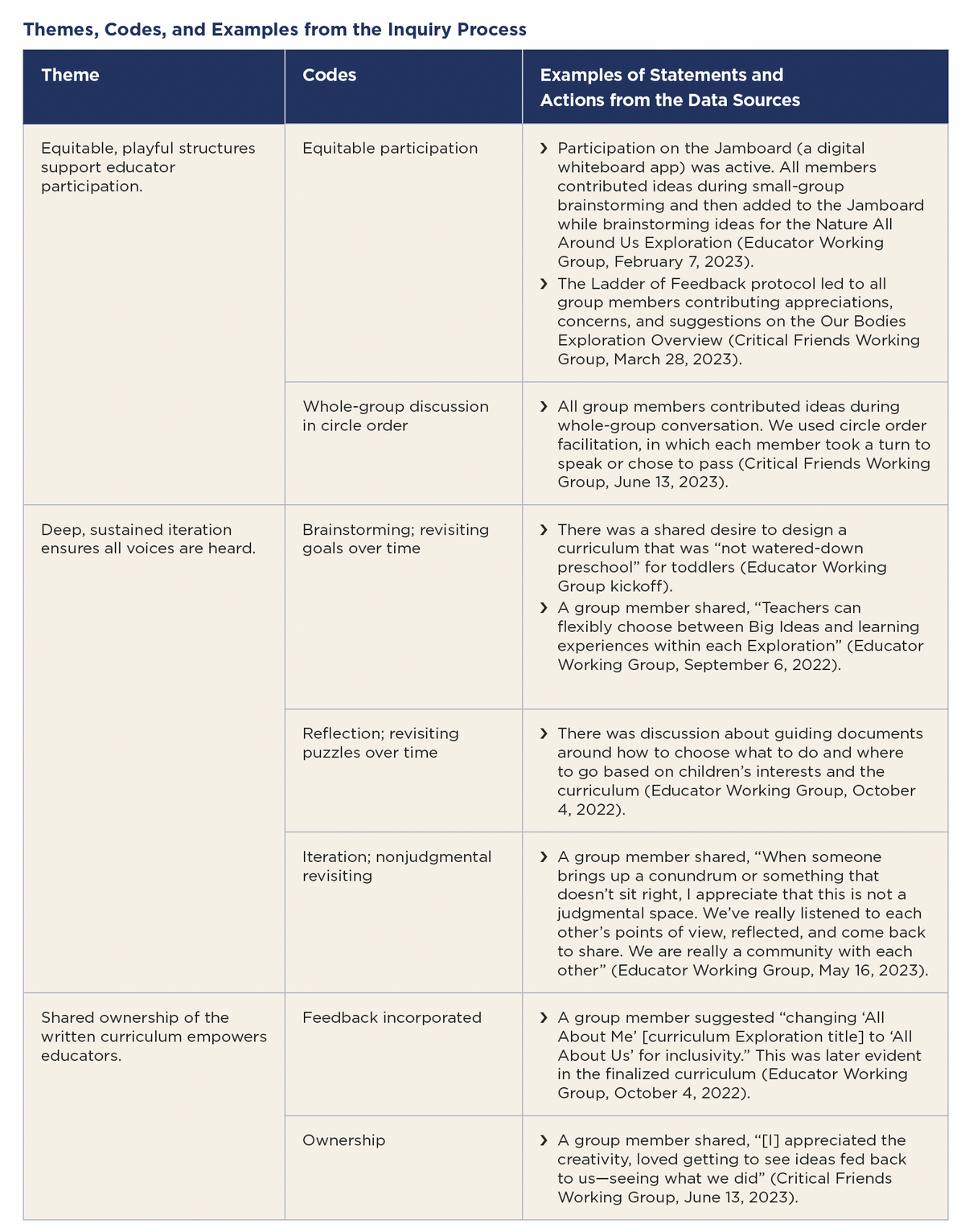
Our analysis identified three themes responding to our research question: What happens when a group of early childhood practitioners engages in sustained, in-depth collaboration to develop a curriculum for toddlers? The three themes are:
Equitable, playful structures support educator participation.
Deep, sustained iteration ensures all voices are heard.
Shared ownership of the written curriculum empowers educators.
Each theme is discussed briefly below. (See “Themes, Codes, and Examples from the Inquiry Process” below for more information.)
Theme 1: Equitable, Playful Structures Support Educator Participation
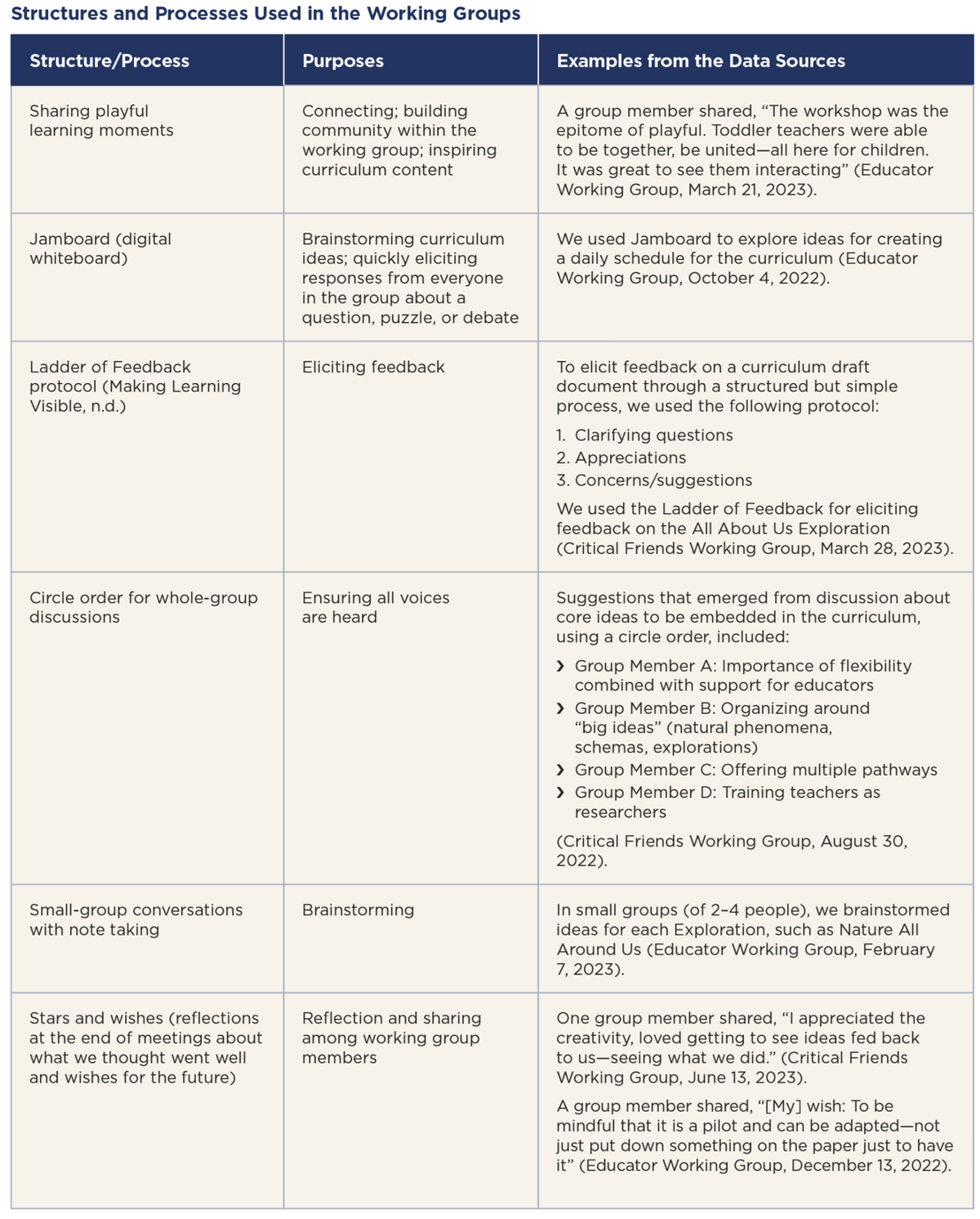
Over the course of the 27 working group sessions, numerous structures and processes were used to facilitate engagement and participation in the digital meeting space. These processes were repeated frequently and served different purposes (building community, brainstorming ideas, resolving puzzles, iterating curriculum documents). Group members frequently expressed appreciation for the ways in which we conducted the sessions.
For example, we began each session with a round of sharing playful learning moments, in which each participant shared about a recent time when they experienced or observed playful learning in their work or personal life. This playful structure helped participants feel motivated to share their ideas with the group and sometimes generated unexpected curriculum ideas. During one Educator Working Group session, a toddler parent willingly shared about her weekend experience with her 3-year-old son: “I loved watching my son’s back and forth—he feels safe with other toddlers. Watching him redirect, his language and development as a leader—nice to see the shift in his relationships with others” (Educator Working Group session, December 2022).
Other playful structures included using playdough and other open-ended materials to represent ideas; brainstorming with interactive structures, such as digital workspaces where everyone could share ideas simultaneously; storytelling; and occasionally acting out an idea or example in a quick dramatization.
The recurring sharing of playful learning moments created a space where participants began to recognize more playful moments and were eager to share connections from their daily lives. At another session, an instructional coach described a moment when she observed a toddler recognize the way their shadow moved with their body while playing with light and shadow (Educator Working Group session, March 2023). Moments like this connected us with each other and also reminded us of some of the core values that underpinned our curriculum writing efforts: Safety, trust, relationships, and joy. All people in the working group, regardless of their jobs or roles, felt empowered to share.
Other processes supported equitable participation, which we believe were key to the authenticity of co-constructing curriculum. For example, using a circle order (ensuring that each person in the group has an opportunity to speak if they wish) or Jamboard (a digital whiteboard space where all participants can add ideas simultaneously) ensured that no one voice dominated the conversation and many different perspectives could be included.
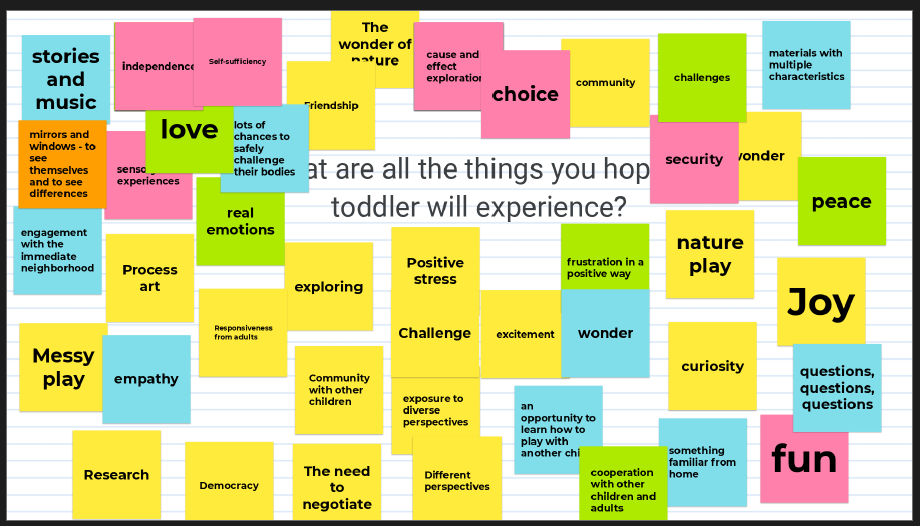
(See above for an example of a Jamboard. See “Structures and Processes Used in the Working Groups” below for additional structures, purposes, and examples from our data of how these played out in practice.)
Theme 2: Deep, Sustained Iteration Ensures All Voices Are Heard
Across our data, we traced moments when the working groups engaged in iterative processes of developing ideas for the curriculum. Iteration was important because it slowed down the decision-making process, ensuring that all voices in the working groups were heard. Iteration occurred both within the Educator Working Group and Critical Friends Working Group as well as across groups and over time. The process of developing a curriculum element began with a brainstorming session, in which all group members weighed in on the topic or puzzle. A subset of group members then processed the brainstorm and generated a draft document to capture the ideas. In the subsequent session, the whole group weighed in again, this time offering feedback, raising concerns, or affirming that the curriculum document felt on target. The document was then revised again and, if needed, brought back to the whole group once more.
For example, when deciding on a topic name for a curriculum unit focused on identity, the first draft for the title was “All About Me.” During a meeting with the Critical Friends Working Group, one member remarked, “The words all about me make me feel we are prioritizing the individual. Is that really what we want? What if we called it ‘All About Us’ instead to focus more on community?” (Critical Friends Working Group meeting, October 2022). This idea was then brought back to the Educator Working Group, who concurred, and the change was made. Repeatedly revisiting the same idea was especially important given that staffing and coverage issues, common in early childhood programs at the time, frequently meant that a group member had to miss a session.
Group members repeatedly commented on the power of this iterative process to elevate their individual contributions toward the development of the documents. One member described the Critical Friends Working Group as “the most comfortable of uncomfortable spaces,” referring to the repeated revisiting and revising of complex curricular puzzles that took place. Another educator explained, “When someone brings up a conundrum or something that doesn’t sit right, I appreciate that this is not a judgmental space. We’ve really listened to each other’s points of view, reflected, and come back to share. We are really a community with each other.”
Theme 3: Shared Ownership of the Written Curriculum Empowers Educators
A final theme highlights the result of the finished curriculum: Members of both working groups expressed feeling a sense of shared ownership over the products they had created. As we reviewed the data, we found many instances of educators’ ideas translating into tangible elements of the finished curriculum. These included books that accompany particular units of exploration and specific ideas for ensuring a trauma-informed lens across the curriculum. Educators noticed this and felt affirmed when seeing their ideas come alive on the page.
During one session, a member of the Educator Working Group proposed a new iteration of a curriculum component template. When given the prompt “What works about this draft? What needs to be added/changed?”, a member responded that it would “be great to have reflection questions prepopulated for teachers to use with children” (Educator Working Group session, November 2022). The group came together to make significant changes to the template, specifically adding repeating reflection questions for teachers to use with children. The shared iterative work and ownership of the written curriculum were both a defining part of the design process.
The data also included multiple moments when group members expressed appreciation for each other’s contributions and pride in their individual ownership. As one group member shared, “I appreciated the creativity, loved getting to see ideas fed back to us seeing what we did” (Critical Friends Working Group meeting, June 2023). In the final sessions for both groups, the stars-and-wishes reflection portion of the meeting was ripe with expressions of ownership and pride about the product we had co-created. (For more, see “Structures and Processes Used in the Working Groups.”) Some members expressed a wish to be able to receive continued feedback from teachers using the curriculum, signaling a desire for continued iteration and collaboration.
Discussion and Significance
The results of this inquiry highlight three critical themes—equitable and playful structures; deep, sustained iteration; and shared ownership—that contributed to the successful engagement of educators in the curriculum development process. These findings align with existing research on participatory design and underscore the importance of inclusive, iterative processes in fostering meaningful collaboration and ownership, particularly in marginalized educational contexts.
The use of equitable and playful structures was a crucial facilitator for fostering a sense of inclusion and psychological safety among participants and reinforced key values—safety, trust, relationships, and joy. These findings resonate with recent studies on playful participatory research, which suggest that collaborative spaces rooted in trust and play can enhance engagement and creativity (Baker & Davila 2018; Baker & Ryan 2021).
The creation of playful, low-stakes entry points for participation may have also mitigated power imbalances within the group, making it easier for participants from varying backgrounds to contribute. This reflects previous findings in collaborative curriculum design research, which emphasize the role of inclusive and dynamic structures in empowering marginalized voices in educational contexts (Pieters et al. 2019; Levitan & Johnson 2020; Mpuangnan & Ntombela 2024).
The iterative process was another key factor, spurring dialogue, a culture of continuous reflection, and a sense of empowerment among participants. It ensured that the curriculum we developed was not only a product of diverse perspectives but also an evolving document that responded to the needs and insights of the group as a whole. This cyclical process of brainstorming, reflection, and revision echoes the principles of design thinking, which emphasize iteration as central to solving complex problems (Dam 2025). It is also important in educational contexts where power dynamics can often inhibit honest reflection (Johnson-Bailey & Cervero 1998).
As group members saw their ideas translated into tangible elements of the final curriculum, they felt an increased sense of pride and responsibility for the work. This shared ownership not only enhanced the quality of the curriculum but also created a ripple effect within the broader community of educators. The effect was contagious: Educators outside of the working groups began to actively engage with and adopt the curriculum, extending beyond the immediate participants. This finding is consistent with past research indicating that when teachers feel ownership over their curriculum, they are more likely to engage with it and implement it meaningfully in their classrooms (Hattie 2011). The shift from passive to active engagement in curriculum-related activities illustrates how shared ownership can lead to more innovative and proactive teaching practices.
Implications for Practice
The results of this inquiry have important implications for curriculum development in marginalized and under-resourced educational contexts. These include:
The value of participatory, equitable design processes in fostering both engagement and ownership. By involving educators directly in the design of the curriculum, this process helped to disrupt traditional top-down models of curriculum development, which are often driven by external, for-profit entities.
The potential for small, community-driven projects to impact broader educational ecosystems. The sense of empowerment and shared ownership that emerged suggests that participatory curriculum design can serve as a catalyst for professional growth and transformation in educational communities. Future research could explore the long-term impacts of this curriculum on both educators and children, particularly in terms of how this sense of ownership influences teaching practices and student outcomes.
Broad applicability of the principles of participatory, iterative, and equitable design. Educators and policymakers in other settings could adopt similar processes to engage local communities in curriculum development, thereby creating more responsive and culturally relevant educational materials. Such efforts may contribute to a larger shift toward educator-driven curriculum design and, ultimately, more equitable educational systems.
Limitations and Next Steps
As with any practitioner inquiry, the scope of this research is small and limited to a particular context. It inherently includes the bias of studying our own practice. Nonetheless, we share our results with humility and in hopes that our process and inquiry may inform and inspire other communities that are marginalized to engage in their own curriculum development efforts. Over time, this could help to shift the dynamics of curriculum development to a more local process that is driven more by educators than for-profit corporations.
One impact from this process has been a growing feeling of empowerment for many of the participating educators. They have demonstrated a gradual increase in joyful and playful experiences with children in their own classrooms and among teaching teams. For example, one classroom shifted from offering only free play with limited materials to engaging enthusiastically with the intentional learning experiences in the curriculum. In preparation for making nature collages, one educator proactively collected flowers, sticks, and leaves on her walk to work. During the experience, another educator ran outside to pick more flowers to add to the collection. Afterward, the teachers sent their coach an email with images of the experience and wrote, “We’ve been trying, and the other teachers have been excited about the activity too.”
We believe that the shared ownership that the working group members experienced in the curriculum design process is now extending beyond our group to other educators within our network. We look forward to expanding our practitioner inquiry to exploring the implementation and impacts of the curriculum over time.
Getting Started with Curriculum Development in Your Setting
For others interested in co-constructing curricula with educators, we suggest the following:
Invite educators to be part of the process from the start.
Offer accessible ways for educators to participate in working group sessions, at times that work for them and with options for in-person or remote participation.
Establish protocols that support inclusive dialogue and an iterative process.
Keep a playful mindset about the process—developing curriculum is messy, fun, and exciting, and the process should reflect that.
Importantly, compensate educators for their expertise and time in the process. Early childhood educators are experts who should not work for free.
About the Authors
Pamela Thompson, MAT, is director of teaching and learning at Neighborhood Villages in Boston, Massachusetts. With extensive early childhood experience, she focuses on strengthening educator practices and supporting quality improvements through leading curriculum development, coaching, and professional learning. pthompson@neighborhoodvillages.org
Sarah Elahi, MA, is an education consultant and curriculum writer based in Boston, Massachusetts. She is the founder of Raising Resistance, an education consultancy providing tailored curriculum and professional learning rooted in social justice values. sarahelahiconsulting@gmail.com
Lisa Goddard, MEd, is a PhD fellow in Reggio Childhood Studies at the University of Modena and Reggio Emilia, Italy. Lisa joined the field of early childhood in 2017 and has served as an educator, curriculum developer, coach, pedagogista, and researcher in Italy and Boston, MA.
Megan Shahnooshi, MA, EdM, is a doctoral student in Human Development, Learning, and Teaching at Harvard University. Her research aims to broaden our understanding of quality in early childhood, especially when it comes to relationships between caregivers and children. meganshahnooshi@gmail.com
Megina Baker, PhD, is a program developer in the Boston Public Schools Department of Early Childhood, Boston, Massachusetts. Megina has over 20 years of experience as an early childhood educator, teacher educator, and education researcher. mbaker3@bostonpublicschools.org
Voices of Practitioners is devoted to teacher research in early childhood education. It appears as a regular column in Young Children. Visit the Young Children archive as well as NAEYC.org/resources/pubs/vop to peruse an archive of Voices articles.
References
Baker, M., & G.S. Davila. 2018. “Inquiry Is Play: Playful Participatory Research.” Young Children 73 (5): 64–71.
Baker, M., & J. Ryan. 2021. “Playful Provocations and Playful Mindsets: Teacher Learning and Identity Shifts Through Playful Participatory Research.” International Journal of Play 10 (1): 6–24. doi.org/10.1080/21594937.2021.1878770.
Bauer, D., S. Fortin, & D. McPartlin. 2006. “Solving the Puzzle of Infant Curriculum: A Model for Infant Curriculum Development.” researchgate.net/publication/240625756_Solving_the_Puzzle_of_Infant_Curriculum_A_Model_for_Infant_Curriculum_Development.
Braun, V., & V. Clarke. 2006. “Using Thematic Analysis in Psychology.” Qualitative Research in Psychology 3 (2): 77–101. doi.org/10.1191/1478088706qp063oa.
Cochran-Smith, M., & S.L. Lytle. 1999. “Relationships of Knowledge and Practice: Teacher Learning in Communities.” Review of Research in Education 24 (1): 249–305. doi.org/10.3102/0091732X024001249.
Cochran-Smith, M., & S.L. Lytle. 2009. Inquiry as Stance: Practitioner Research in the Next Generation. Teachers College Press.
Dam, R.F. 2025. “The 5 Stages in the Design Thinking Process.” Interaction Design Foundation. interaction-design.org/literature/article/5-stages-in-the-design-thinking-process.
Derman-Sparks, L., & J.O. Edwards. With C.M. Goins. 2020. Anti-Bias Education for Young Children and Ourselves. 2nd ed. NAEYC.
Ebbeck, M., S. Warrier, & M. Goh. 2018. “Early Experiences Matter: A Relationships-Based Curriculum for the Birth-to-Three Age Group.” Early Childhood Education Journal, 46: 83–92. doi.org/10.1007/s10643-017-0847-9.
Escamilla, I.M., & D. Meier. 2018. “The Promise of Teacher Inquiry and Reflection: Early Childhood Teachers as Change Agents.” Studying Teacher Education 14 (1): 3–21. tandfonline.com/doi/full/10.1080/17425964.2017.1408463.
Hammond, R. 2019. Respecting Babies: A Guide to Educaring for Parents and Professionals. 2nd ed. ZERO TO THREE.
Harmon, F., & R. Viruru. 2018. “Debunking the Myth of the Efficacy of ‘Push-Down Academics’: How Rigid, Teacher-Centered, Academic Early Learning Environments Dis-Empower Young Children.” Journal of Family Strengths 18 (1). doi.org/10.58464/2168-670X.1390.
Hattie, J. 2011. Visible Learning for Teachers: Maximizing Impact on Learning. Routledge.
Henderson, B. 2025. “The Pedagogical Narrative as a Form of Teacher Research.” Young Children 80 (2): 66–75.
Hester, M. 2018. “Why Is Public School Curriculum Still Whites Only?” Metropolitan Center for Research on Equity and the Transformation of Schools, NYU Steinhardt. steinhardt.nyu.edu/metrocenter/why-public-school-curriculum-still-whites-only-2018.
Horm, D.M., C.B. Goble, & K.R. Branscomb. 2012. “Infant Toddler Curriculum: Review, Reflection, and Revolution.” In Curriculum in Early Childhood Education: Re-examined, Rediscovered, Renewed, eds. J.J. Mueller & N. File. 1st ed. Routledge.
Horm, D.M., K.-A. Kwon, & D.E. Laurin. 2019. “Infant-Toddler Curriculum: Reconsider, Refresh, and Reinforce.” In Curriculum in Early Childhood Education: Re-examined, Reclaimed, Renewed, eds. J.J. Mueller & N. File. 2nd ed. Routledge.
Howell, D., A. Norris, & K.L. Williams. 2019. “Towards Black Gaze Theory: How Black Female Teachers Make Black Students Visible.” Urban Education Research & Policy Annuals 6 (1): 20–30.
Johnson‐Bailey, J., & R.M. Cervero. 1998. “Power Dynamics in Teaching and Learning Practices: An Examination of Two Adult Education Classrooms.” International Journal of Lifelong Education 17 (6): 389–99. doi.org/10.1080/0260137980170605.
Kelly, M. 2018. “How to Make the First Thousand Days Count.” Health Promotion Journal of Australia 29 (S1): 17–21. doi.org/10.1002/hpja.58.
Levitan, J., & K.M. Johnson. 2020. “Salir Adelante: Collaboratively Developing Culturally Grounded Curriculum with Marginalized Communities.” American Journal of Education 126 (2). doi.org/10.1086/706921.
Liu, C., L. Solis, H. Jensen, E.J. Hopkins, D. Neale, et al. 2017. “Neuroscience and Learning Through Play: A Review of the Evidence.” The LEGO Foundation. doi.org/10.13140/RG.2.2.11789.84963.
Making Learning Visible. n.d. “Ladder of Feedback.” Accessed July 26, 2023. makinglearningvisibleresources.org/ladder-of-feedback-see-supporting-learning-in-groups-in-the-classroom.html.
Mardell, B., J. Ryan, M. Krechevsky, M. Baker, S. Schulz, et al. 2023. A Pedagogy of Play: Supporting Playful Learning in Classrooms and Schools. Project Zero. pz.harvard.edu/sites/default/files/PoP%20Book.pdf.
Mpuangnan, K.N., & S. Ntombela. 2024. “Community Voices in Curriculum Development.” Curriculum Perspectives 44: 49–60. doi.org/10.1007/s41297-023-00223-w.
NAEYC. 2022. Developmentally Appropriate Practice in Early Childhood Programs Serving Children from Birth Through Age 8. 4th ed. NAEYC.
Noffke, S.E., & B. Somekh, eds. 2009. The SAGE Handbook of Educational Action Research. SAGE Publications.
Otten, J.J., V.A. Bradford, B. Stover, H.D. Hill, C. Osborne, et al. 2019. “The Culture of Health in Early Care and Education: Workers’ Wages, Health, and Job Characteristics.” Health Affairs 38 (5): 709–20. doi.org/10.1377/hlthaff.2018.05493.
Perry, G., B. Henderson, & D.R. Meier, eds. 2012. Our Inquiry, Our Practice: Undertaking, Supporting, and Learning from Early Childhood Teacher Research(ers). NAEYC.
Pieters, J., J. Voogt, & N.P. Roblin. 2019. Collaborative Curriculum Design for Sustainable Innovation and Teacher Learning. Springer.
Reason, P., & H. Bradbury 2001. Handbook of Action Research. SAGE Publications.
Saldaña, J. 2012. The Coding Manual for Qualitative Researchers. 2nd ed. SAGE Publications.
Photographs: First photo, © Getty Images; second photo, courtesy of the authors
Copyright © 2026 by the National Association for the Education of Young Children. See permissions and reprints online at NAEYC.org/resources/permissions.