Two special concerts celebrating 24 years of music-making with Mr Dyer.
CHORAL CONCERT
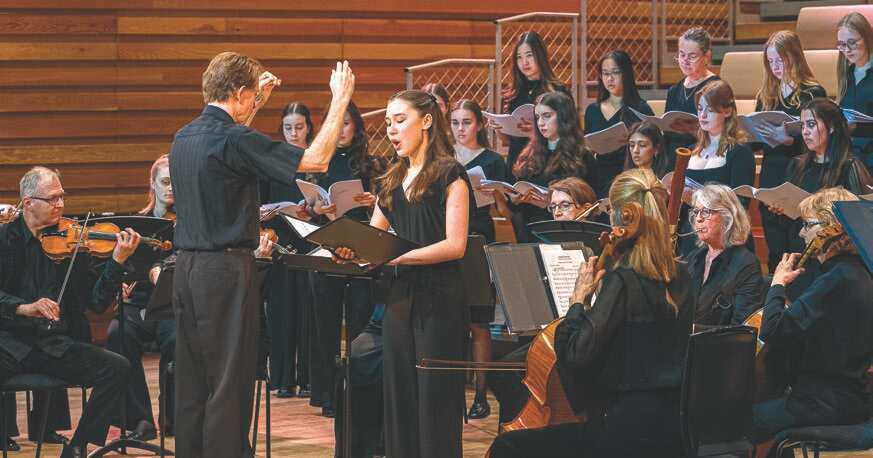
‘It is an absolutely spine-tingling moment,’was Mr Dyer’s comment in the programme notes, referring to the magnificent opening of Handel’s ‘Zadok the Priest ’, and this perfectly encapsulates the evening of Friday 20 March in the Pamoja Hall.
The choral Music at Sevenoaks concert featured an extensive repertoire, beginning with ‘Calon Lân’, by John Hughes and Daniel James, and ‘Rainbow Connection’by Paul Williams and Kenneth Ascher, performed by the Junior Chamber Choir, directed by Miss Eccleshall. This was followed by Rachel Fogarty’s ‘To the Flowers that Spring’ sung by the Upper Voices directed by Ms Day, and a riveting a cappella of Billy Taylor’s resonant ‘I Wish I Knew How It Would Feel to Be Free’ by the Voices of Freedom, also conducted by Ms Day.
The Sennocke Consort, conducted by Mr Dyer, as well as performing Mozart’s ethereal Laudate Dominum and Thomas Tallis’s beautifully crafted first Lamentation, showcased the creative talent of the Upper Sixth with two unique pupil compositions. ‘O God, my Lord and Saviour ’, by Noah Davis, a hymn-like composition marked by its majestic and solemn tone, was conducted by Seia Yano. The piece’s
stately tempo and rich harmonic structure created a powerful, reflective atmosphere which contrasted with Eve Ward’s ‘A Madrigal’. Eve’s composition featured a sophisticated polyphonic texture, creating an enchanting, interwoven vocal tapestry which she conducted with the poise of a seasoned musician.
The programme’s second half featured a monumental ensemble of over 150 performers, comprising the Choral Society, the Parents and Friends Choir, and orchestra, who delivered five celebrated choral pieces with extraordinary scale and resonance. What connected the pieces – Handel’s ‘Zadok the Priest ’, Haydn’s ‘The Heavens Are Telling’, Brahms’s ‘ Wie Lieblich Sind Deine Wohnungen’, and the Libera Me from both Fauré’ s and Verdi’s Requiems – was the deeply personal connection they hold in Mr Dyer’s musical journey.
The concert’s unabashed diversity served as a graceful coda to Mr Dyer’s 24 years at Sevenoaks. With all five academic Music staff conducting a choral masterpiece in the second half and six student soloists, the evening was a direct testament to Mr Dyer’s career-long commitment to inclusivity and a profound realisation of the sheer breadth of talent he has fostered.
Emeline Ang, Lower Sixth
ORCHESTRAL CONCERT
At the principal ensemble event of the year, students from the school’s many instrumental groups filled the Pamoja Hall stage. Thanks to the Music department staff who direct groups like the Wind Band and Sevenoaks Strings, ensembles like these have thrived over the years. This concert took it further, involving several student-led groups as well.
The Wind Band opened with dynamic pieces such as ‘Wind Power’by Robert Buckley and‘Secret Valley ’by Michael Sweeney, as well as a new March for Wind Band, composed and conducted by Evan Brooke (Upper Sixth). Sevenoaks Strings followed, with a nostalgic and melancholic rendition of Grieg’s Holberg Suite.
The Chamber Orchestra came next, with a fully student-directed programme. Under Mr Dyer’s guidance, Dennis Zhu Wang (Lower Sixth) and I had the opportunity to conduct two of Mozart’s compositions – his Adagio and Fugue in C Minor and the first movement from his Violin Concerto no 4 in D, which I directed as the violin soloist. Having this opportunity to lead beyond the usual school routine, and to perform alongside such talented friends, has been one of the most rewarding experiences I’ve had here at Sevenoaks.
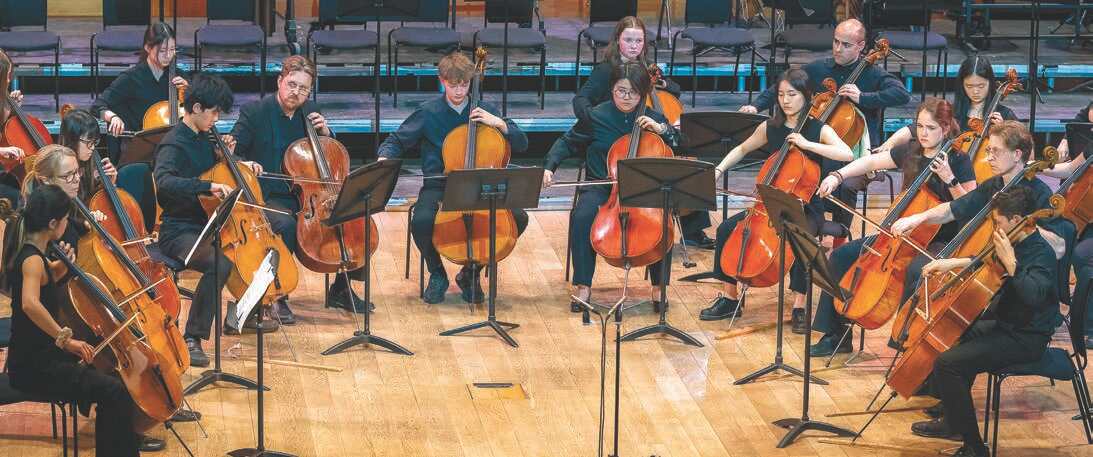
A highlight of the night was the Cello Ensemble’s performance of Barber’s Adagio for Strings, a magnificent display of 26 cellos filling the stage. Citing an exceptionally strong cohort of cellists, Mr Dyer was inspired to adapt Barber’s composition, originally for string orchestra, into one for cellos. (I must say I’m quite jealous that the other string instruments were out of the mix – I would’ve loved to play it.) The extensive ensemble included students from Year 7 to the Upper Sixth, Old Sennockians, staff and future students – a show of the breadth within the department and the opportunity available for all.
The second half brought Tchaikovsky’s legendary Fifth Symphony, performed by the Symphony Orchestra under the electrifying baton of Mr Dyer. The audience followed the fateful journey of the music, culminating in the fourth movement’s victorious finale – fittingly mirroring Mr Dyer’s triumphant path as he steps down from his role as Director of Music this year. His poignant speech afterwards moved the crowd to their feet – a well-deserved ovation for his years of dedication and the indelible mark he has left on the school.
Mika Woo, Lower Sixth