“An oak tree spends 300 years growing, 300 years living, and 300 years dying.” —traditional proverb
~by Jim Eagleman
I felt a tinge of regret as I fed the red oak logs into the log splitter. This big tree grew tall and straight. The exposed wood showed the straightest grain of any oak you would ever want—for flooring, furniture, or woodworking.
I had other plans. Its main trunk would yield stove length logs. I keep this length in mind each time I use the chainsaw, and attempt to cut the wood in equal sizes. The work is easier if logs are all the same length, for stacking, carrying, and loading into the stove.
My brother-in-law, a woodworker who lives north of Chicago, learned of my intended use of this magnificent tree. He yelled into my phone, “You gotta be kidding! You buzzed it up for firewood?” He typically doesn’t see this straight-grained growth in the discarded pieces he scavenges. Oaks of this caliber are rare. Those of similar size are usually found in the Cook and Lake County forest preserves, characteristic of the savannahs of northern Illinois. He wanted to come the next day with his large trailer to cart the logs back to his home.
Doug Tallamy, author of the book The Nature of Oaks, the rich ecology of our most essential native trees, says of the oaks, “They are, in general, long-lived trees, and members of the red oak group can easily live many hundreds of years if their roots are given free reign and not impeded by sewer lines, basements, and parking lots. A single oak tree will drop up to three million acorns over its long lifetime, and will serve as a lifeline for countless creatures including dozens of birds, rodents, bears, raccoons, opossums, rat snakes, fence lizards, and a group we don’t consider: several butterflies, hundreds of moths, gall wasps, weevils, and dozens more species of arthropods, mollusks, and annelid worms that depend on oak leaf litter for nourishment and protection.”
The red oak, scientific name Quercus rubra, is a Brown County tree I want to know more about.
Unfortunately, the diverse web of life associated with oaks goes unnoticed and mostly unappreciated by many homeowners, and even some biologists I know. In fact, many homeowners cut down their oaks because they have grown tired of the mast crop and raking leaves.
My oak was destined for removal, not because of leaves or an occasional broken branch, but because of its close proximity to a building. A tree company I hired last summer to remove dangerous limbs hanging over the roof, looked at the oak, and without hesitation, said, “That oak is a threat, Jim. Think of the damage it could do if it fell on that structure.”
It took a crane with outriggers and an operator with controls to maneuver and cut the top-most limbs, a day-long job. With ropes and slings, two employees coaxed the tree-sized branches swinging wildly overhead to the ground. A shredder reduced smaller limbs and branches to a pile of mulch dumped on site. I wound up with more wood than I ever expected.
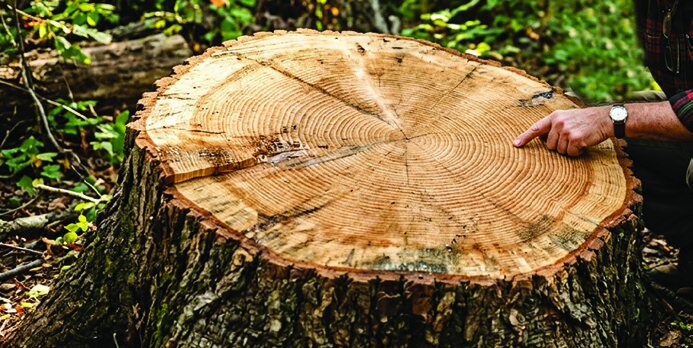
Heating with wood, I’ve come to know the approximate amount I’ll need to get through the winter. I have enough wood that should last for years, but the red oak will be used as it seasons. The exposed stump, at least three feet in diameter, gave me a chance to count the growth rings. On a warm afternoon with the sun’s rays casting just the right amount of light, I counted them slowly—some were very close together, some had gaps up to a quarter inch. There were about 115 rings which means this tree began its growth around 1893.
I thought of this place, back to that time, and the tree’s tiny start as a seedling.
Foresters tell us the Brown County forest is an overlap of the beech-maple and oak-hickory communities. From my experience of walking the state park’s many trails, and from surveys on our property, I observed that the American beech and sugar maple trees typically occupy the slopes. The higher and drier ridges are where the oaks, pignut, and shagbark hickory live. Both forest types reveal a similar shrub layer of dogwood, musclewood, spicebush, and ironwood, but you’d be hard-pressed to see where one type ends and another begins.
Of the two oak groups: the white oak and the red oak, it’s the white oaks that far outnumber the reds. You will often see a large number of white oak logs cut and laying on the ground across from the old Little Nashville Opry property along State Road 46 near the west entrance of the Brown County State Park.
Oaks yield tannic acids, the bark used in early times for leather preservation. The chestnut oak, Quercus montana, a white oak family member, still prevails in our Brown County hills despite its wasteful use. Its bark was stripped from felled logs using tools called peeling spuds. This tree helped shape our culture and the reason seven leather tanneries were established here between 1850 and 1893, the year my red oak started to grow.
Like you, I love living in this county with a close connection to its forest. The Brown County art colony attracted artists who painted the rugged landscapes. They first captured the beauty of oaks on these hazy hills. Our continuing forest industry, if managed wisely, will be with us forever.
This red oak’s wood will be used next heating season. The tree left a place for sunlight to grow the next little red oak.