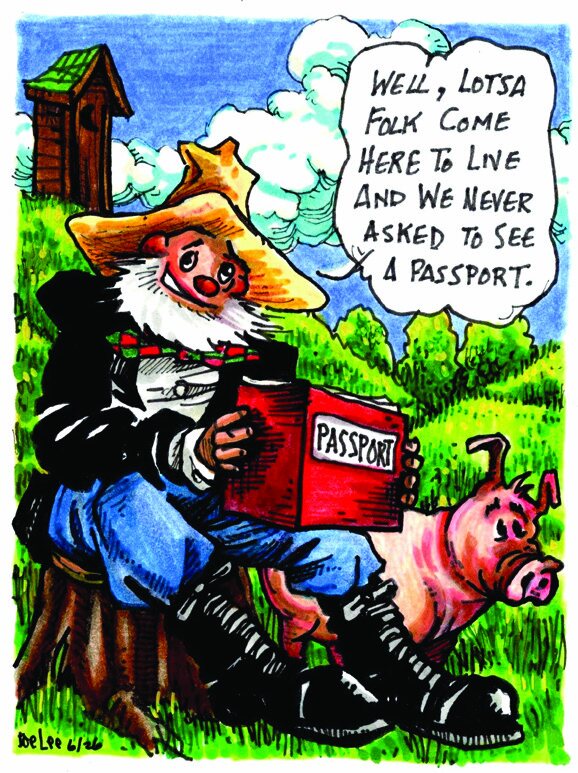
~by Mark Blackwell
I used to live in a place between Lake Lemon and Lake Monroe, directly in the path of migrating sandhill cranes, Canada geese, and other winged creatures. It made for interesting autumns and springs. The overhead honking and whooping were auditory announcements that the seasons were changing.
I enjoyed hearing honks and looking into the sky to see the “V ” pattern of the geese. Sometimes when I heard the cranes, I would search for them in the sky, but they would fly so high that they couldn’t be detected by sight. Their presence was perceived only by their faint fading calls. I was glad I lived in the path of north- and south-bound birds and not in the way of some other creatures like buffalo or elk.
But it isn’t just our animal brothers and sisters that migrate, human beings have a propensity to wander around, as well. In the far recesses of our past, people migrated north out of Africa. Then there were migrations from east to west by the Huns and Scythians. In Biblical times, Moses led the Hebrew children on a 40-year migration into and around the wilderness of the Middle East.
As soon as the Europeans could engineer ocean-going vessels, they continued the east-to-west migration to a “new world.” But that new land had already been settled by folks migrating from west-to-east. All this got me to thinking about Brown County. After all this thinking on a grand scale, it is worthwhile to shrink things down and look at migration from a smaller historical viewpoint. First off, Brown County has only existed as a legal entity for less than 200 years. But in that time period it has seen at least five distinct waves of migration by humans.
The first would be Native Americans. We know they came and explored and hunted this area but there is scant evidence that they established any lasting settlements. There was an early German pioneer named Johann Schoonover, who lived somewhere in the valley named for him (later shortened to Schooner) and reportedly traded with Native Americans.
Next, came the permanent settlers. The first of whom, in 1820, was William Elkins. Others followed. By 1836, when Brown County was officially established, there were around 2,000 settlers, more or less. This population was scattered around and primarily lived on self-sufficient farmsteads.
This way of life continued right into the 20th century, when a third migration occurred. Artists, mainly painters, discovered Brown County. This migration was started by Theodore C. Steele, who built a home and studio near Belmont in 1907. By 1917, artist Adolph Schulz with his wife Ada, also an accomplished painter, moved to the county and proselytized its scenic virtues to friends and fellow artists.
In 1926 there were enough artists in and around Nashville to start a formal “Brown County Art Gallery Artist Association.”
Despite diligent research, I have not been able to uncover any of the association’s initiation rites, passwords, secret handshake, or information regarding ritual regalia. But I will keep trying.
Paint, canvas, and easels were not all that the migrating artists brought with them.
This was the first migration of sophisticated outsiders. They brought knowledge of the outside world. Many of the artists studied in Europe and had lived and worked in places like Chicago and New York City. They brought new ideas, fashions, and mores. Some of the local folks looked at the newcomers with amusement and some with disdain. One county resident is said to have remarked that “It looked like plumb ignorance,” after watching an artist go about his business of painting the landscape.
By the early 1920s, word about Brown County’s unique scenery, quaint log cabins, and reluctance to adopt 20th century progress spread across the Midwest. Some of this was due to word of mouth, and some because a feller named Kin Hubbard started publishing observations he got from Brown County commentator “Abe Martin” in the Indianapolis News and syndicated in newspapers across the country.
In addition to Hubbard’s work, another transplant to Brown County, Frank Hohenberger, started photographing everyday scenes and people in and around Nashville. He wrote a column for the Indianapolis Star entitled, “Down in the Hills o’ Brown County.” This garnered more attention for this little patch of Indiana and tourists.
Americans in the 1920s were beginning to enjoy the fruits of a modern industrial economy. Jobs were more prevalent and better paying. It was getting harder to “keep them down on the farm” since there were affordable automobiles. I believe that some of the tourism was in part nostalgia, and part bringing the younger generation down here to show what life had been like not long before.
The last wave of migration to the county started in the 1960s. There was an idea going around that young people had to get out of the urban environments, move to the country, get land (optimally communally) and gain skills to be self-sufficient both physically and spiritually. So, where better to do that than a place where people had already been living that way for generations.
The young folks who moved here in the 1960s brought with them enthusiasm and optimism. They settled in and plied their crafts. There were potters, blacksmiths, candle makers, leather workers, and gardeners. It was a new beginning using old ways.
There were many successes, and some failures, but the “back-to-the-landers” revitalized Brown County with overall positive changes.