~by Jim Eagleman
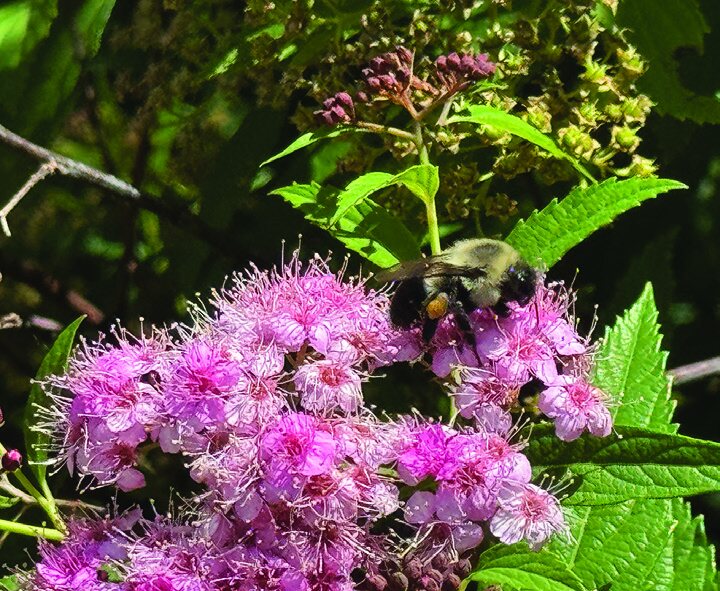
The large blooms of our wild hydrangea plants by the porch were weighed down heavily after having flowered weeks before. Rain had contributed to their droop and bent the blossoms at odd angles. Ringed layers of little flowers added depth.
The browsed branch tips the deer left that morning didn’t deter the bees. Bees of all sizes and shapes crawled over the blooms. Some hovered, and some landed quickly. A few flies and a fritillary also moved on them, but mostly bees. Some were so tiny I had to really look close.
These were all solitary bees, not the larger honey bees I had come to know.
An observation hive we once had at the park’s nature center attracted many campers with questions. I learned a lot about honey bees so I could offer explanations. They gather and make honey in the stomach, then store it in communal cells for the developing young.
The solitary bees make up more than 90% of the roughly 3,600 species of bees in North America. And like their name, they live alone with each female constructing a nest without any help from a swarm or colony. They live about a year, and the active adult stage lasts about three to six weeks. These insects spend the other months hidden in a nest, growing through the egg, larval, and pupal stages.
Bee activity on the hydrangea was different from what I saw with wasps and beetles. A female solitary bee could visit hundreds of flowers on her foraging trip, but she is normally there to only get the pollen. Nectar she may gather is mostly for her own energy, and some combined with pollen for the brood. In contrast, butterflies, moths, wasps, and flies visit flowers to feed on nectar and do not collect pollen.
Our native gardens, gradually gaining color and space, provide both nectar and pollen, creating some important components of a healthy ecosystem.
You may have seen solitary bee “tubes” in garden stores. These hollow stems, about six inches long, are bundled together into little houses to install around the garden. The female solitary bee has amazing engineering skills and can chew out a nest within the soft central pith of stems and twigs. Bamboo and other hollow twigs help encourage nesting.
The other roughly 70% nest in the ground, digging tunnels in bare, well-drained soil. My wife Kay and I discard hollow stems within fall plants to a pile to overwinter. Then we look for brood chambers in these stems during spring.
One solitary bee, the large carpenter, can cause a nuisance as the female bores holes into wood around the home. She targets soft cedar trim and soffit boards. You can hear buzzing noises during excavation. Telltale sawdust piles accumulate near the holes.
As an alternative to insecticides, jars can be installed to trap the live bees. The bees can then be released elsewhere, and the holes can be filled with caulking. Female carpenter bees have stingers that contain venom. It is not dangerous to most people, but anyone with allergies should be cautious.
Because bees can sting and are sometimes harmful, we might think of them as “The only good one is a dead one.” But, how we accept all parts of nature —some good, some requiring more attention, some to avoid—allows for intelligent forward thinking, a conscience, and ultimately, a responsibility.
Increasing our awareness of insects and the role they play, and learning about the many crops, produce, and nuts that are dependent on them, help us to appreciate the complexity of our ecosystems.
Conservation of insects in general makes sense. It is part of a stewardship mantra, vital to sustain balance. Pollinators are essential to our environment. The service they provide is necessary for the production of over 85% of the world’s flowering plants, and more than two-thirds of the world’s crop species.
The native hydrangea drama I watched each morning is nothing new. It happened before we transplanted them, only now am I paying attention. The plant attracts the solitary bee, visited mostly for the pollen, and life continues. Pollen is food for the developing offspring back in the nest, and a means to fertilize another plant on the next visit. Some bees loyally visit one particular plant species in bloom (termed flower constancy), while other solitary bees gather pollen from many different plants indiscriminately. With no others to communicate source, direction, and nectar quality, it is thought the solitary bee is left to visit a wider range of plants than the honey bee. They don’t compete and there is no overlap. Niches are filled.
An introductory class in entomology was my first chance to observe insects under the power of a lab microscope. We were able to see the tiny features on those hairy bodies close up. Wings, legs, and eyes were revealed—almost grotesque. I viewed the solitary bees as a group and they were more varied in length alone from about 1/12 inch to more than 1 inch.
Lectures disclosed facts about plant-insect relationships and the mechanics of fertilization.
“Any good biologist is also a good botanist,” said one professor, adding “and also a good entomologist.”