~by Brian Blair
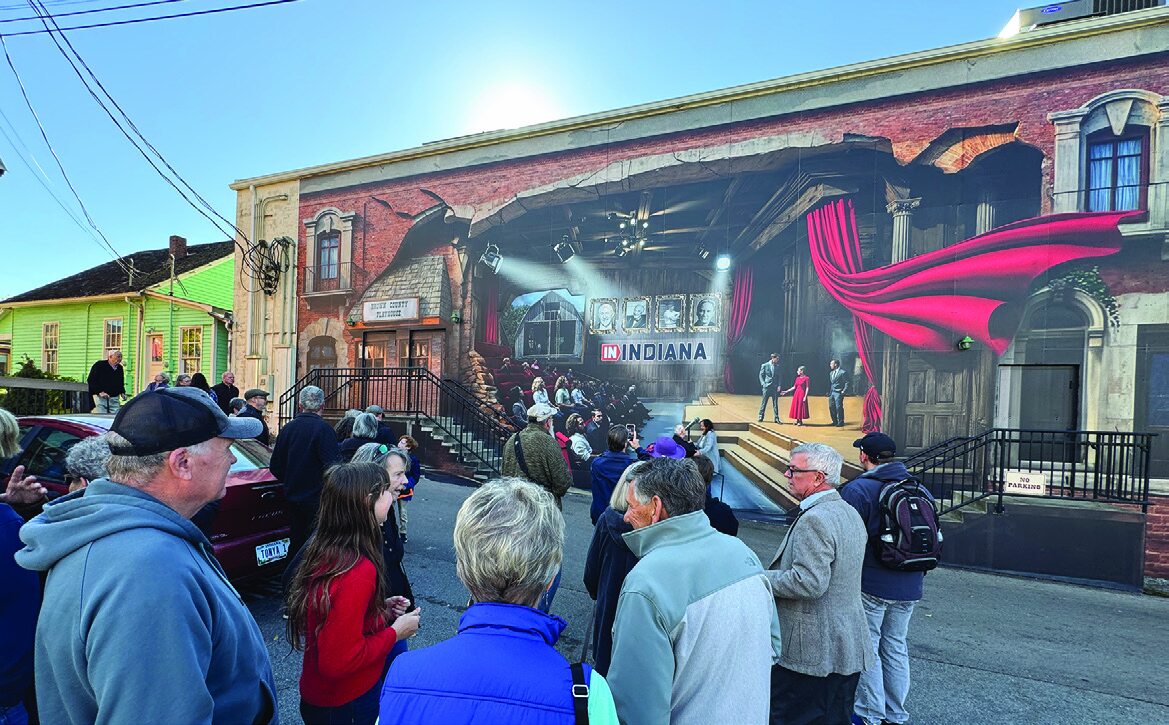
Since 2023, Kathy Anderson dreamed of seeing the Brown County Playhouse’s varied arts spotlighted on the outside of the building within a huge, blank area visible to people walking around Nashville.
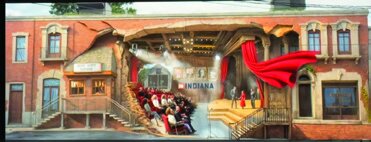
Today, her desire stretches 72 feet by 28 feet in full color on the north side of the structure, facing Old Hickory Lane.
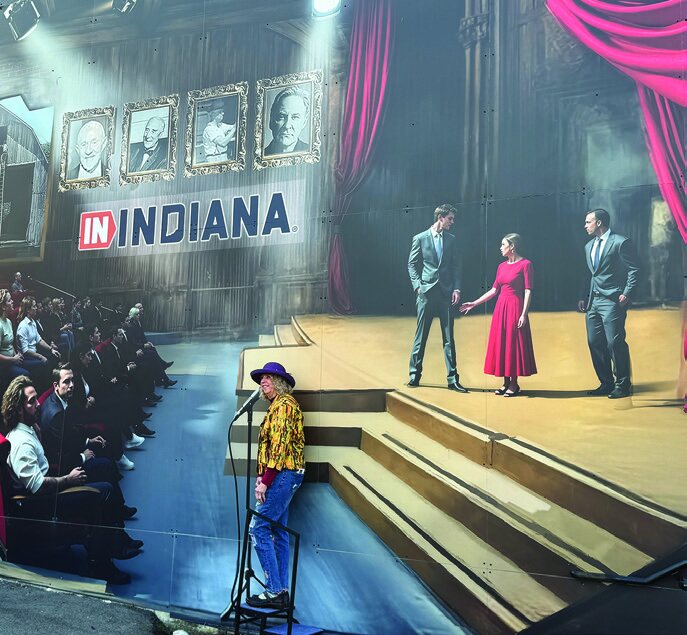
A digital theatrical scene created by rising Turkish-born artist Sitki Dogan, whose work appears nationwide, in Europe, and in the Middle East, features younger audience members watching a production at the intimate, 375-seat venue.
The crowd depiction, meant mostly to be a draw especially to prospective younger ticket buyers, was something of a team effort among board members and Dogan after the artist perused historical photos of the playhouse.
“They’re just meant to be a reference to young people today,” Dogan said, speaking by phone from his home near Palm Beach, Fla.
The barn details in the image represents the early playhouse stage site that opened in 1949 with tent-covered seating. The playhouse began as Indiana’s first post-World War II summer stock theater, a collaboration between Indiana University Theater Director Lee Norvelle and local businessman A. Jack Rogers, launching with lowbudget shows to highlight the arts—all with the help of drama students seeking stage experience.
At the time, there might have been equal drama with building an audience in a hamlet not quite claiming 500 residents.
Rogers and Norvelle, plus nationally-known actors Kevin Kline and Jonathan Banks, who got their start at the playhouse, are depicted in framed photos within the mural to help highlight the facility’s distinguished history.
“I especially like the 3-D effect on the windows (of the building),” Dogan said.
“He [Dogan] really is gifted,” said Anderson, a Playhouse supporter and former president. “And he clearly had more [mural] experience than anyone else who submitted a proposal.”
Though Anderson initially and put out a call last year for local creators in the well-known artists colony, she heard nothing after two months. She expanded the search statewide and even heard from artists globally. She found Dogan, known especially for his 3-D perspective style of street and festival art.
A $43,000 total grant from a mix of the Indiana Destination Development Corporation, the Nashville Arts and Entertainment Commission, and individual donors, funded the physical printing and installation expense of the image. An additional $5,000 paid Dogan for about three months’ effort.
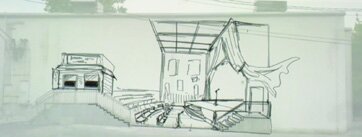
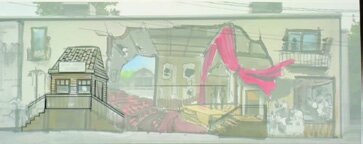
“They liked my first sketch I showed them,” Dogan said. “They liked the view, perspective and effect.”
Three finalists also were paid $250 for their submissions.
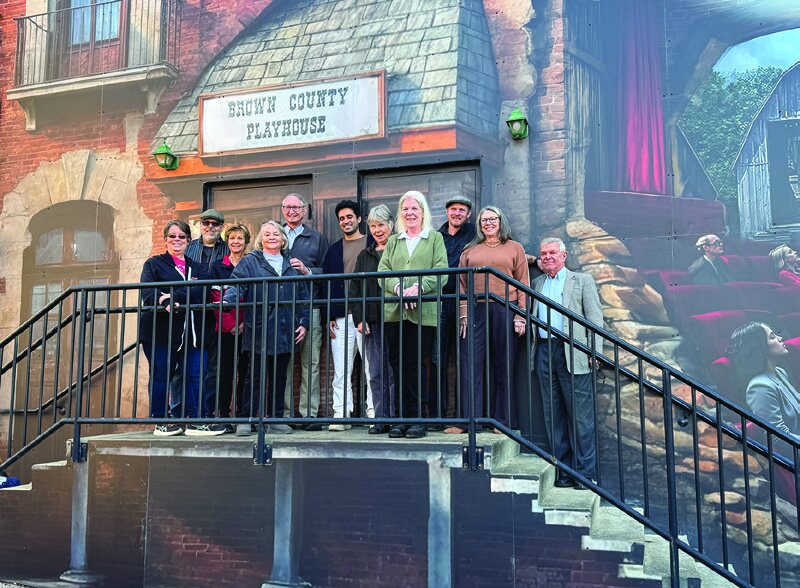
A Nov. 4 dedication before about 40 people celebrated the manifestation of the artist’s efforts. Anderson liked the idea that Dogan, who now lives near Palm Beach, did his own research on the playhouse and its history before submitting several artwork concepts. Others are discovering his talent that includes a passion for sketching airport travelers.
Earlier this year, he earned the Palm Beach Cultural Council’s Emerging Artist Prize and completed an artist residency at the Norton Museum of Art in West Palm Beach.
Dogan, who came to the United States from Instanbul in 2022, also does extensive and elaborate tattoo work.
Anderson, who specifically hoped to find someone with the 3-D gift known as trompe-l’ œil (meaning deceive the eye) loves the fact that the mural could earn him more work statewide.
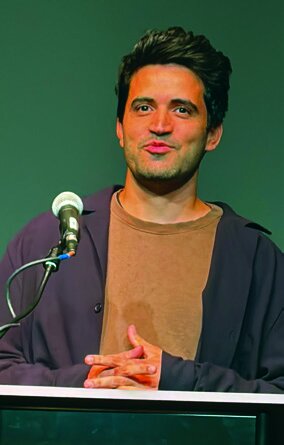
The artist Sitki Dogan spoke to the dedication day attendees and shared a video he made depicting the evolution of the mural’s progress.
“Once we picked him, I wanted him to get exposure in Indiana because there are a lot of murals done here,” Anderson said.
Dogan began with sketches done on an iPad. Though some people on social media expressed a measure of disappointment with art that they termed “A. I.,” artists have successfully used some electronic tools for various styles of work for years.
Anderson is tickled to see the building’s exterior reflect as much creativity as the interior, which is a home to plays, movies, concerts, comedy, competitions, and much more. And she’s delighted that Bloomington business Everywhere Signs’ printed depiction of Dogan’s scene in a series of 70 aluminum composite panels pieced together “will last a lot longer than paint out there.”
Carolyn McCutcheon, playhouse executive director, acknowledged that the vision of the artwork dates back a while.
“The mural has been a dream of many past and current board members of the Brown County Playhouse,” McCutcheon said. “We are thrilled that it is now a reality. It is hoped that it will be enjoyed by both visitors and locals.”
The playhouse’s Facebook page proclaimed the work as more than décor for what Anderson always previously saw as “that big blank wall.”
“This isn’t just a mural,” read one post. “It’s a celebration of the arts, community, and the magic that happens here.”