Market Trends
Private equity changes culture and boosts business
Written by PAUL WILBUR
“When a franchisor gets bought out by private equity, there is always a resounding cry of celebration by the franchisees,” said no one. On a popular franchise Facebook group, franchisees are often caught between optimism and unease.
Recently, I read this post: “The new owners are sharp with numbers, but something about the brand’s soul feels different.” Many describe a shift in culture and connection where founder-led passion and accessibility give way to structure, performance metrics, and distance from day-to-day realities. For operators on the ground, the question isn’t just about financial backing; it’s about whether the values, support, and sense of partnership that once defined their system will survive the transition.
Yet at the same time, we’ve been told by very successful franchisees that they only want to invest in franchise brands that are owned by smart money. The reason is that smart money makes rational decisions, not emotional decisions based on gut, sense of ownership, or loyalty.
Do you remember back in 2002, when the Fenway Sports Group (FSG) purchased the Boston Red Sox from the Yawkey family, which had owned the team since 1933? FSG was a consortium of owners that included Redbird Capital Partners, a private equity group.
The team lost something of its historic hometown feel. It made unpopular trades based on budgets. The group looked far beyond the Boston market at international development opportunities. Many fans were unhappy.
And then the Red Sox won the World Series for the first time since 1918, finally breaking the “Curse of the Bambino,” which started when the team traded Babe Ruth to the New York Yankees. The Red Sox won the series three more times over the next 15 years. FSG also purchased Liverpool F.C., making it one of the largest sports groups in the world and valued at $5 billion or more.
As in professional sports, private equity’s entrance into a brand’s world tends to spark some tension between tradition and transformation, and we don’t foresee a slowdown of PE acquisitions in the near future. Most national brands and many local and regional brands on fast-growth trajectories already have investors or are being looked at very carefully. Analysts are at the emerging brand and franchisee shows to size up opportunities.
There’s no doubt that this is changing the industry. Private equity management feels quite different from founder-run brands. Franchising is an industry made up of entrepreneurs, and franchisees sometimes choose to join a system as much for the founder’s vision as for the financial potential.
Founders don't just run a business. They want to make a difference in the lives of their customers and franchisees. They are proud of what they are selling, and that enthusiasm is shared by their franchisees.
Founder-run brands made personal connections. Decisions took the franchisee’s situation into account. For instance, many franchisors only collected liquidated damages if you had to close a unit before the end of term under egregious circumstances. A franchisee could call the founder or the head of ops and reach an agreement on how to proceed. Now, your formal written application is reviewed by a governing committee, and the outcome is a foregone conclusion.
That is not a bad thing in business. Having and enforcing policies and procedures is smart. It’s predictable. It’s fair. Disciplined processes make a business better. To improve operations, PE invests the capital needed to solve system problems. Groups invest in smart technology and add innovations that make a franchisee’s life better. And the system grows.
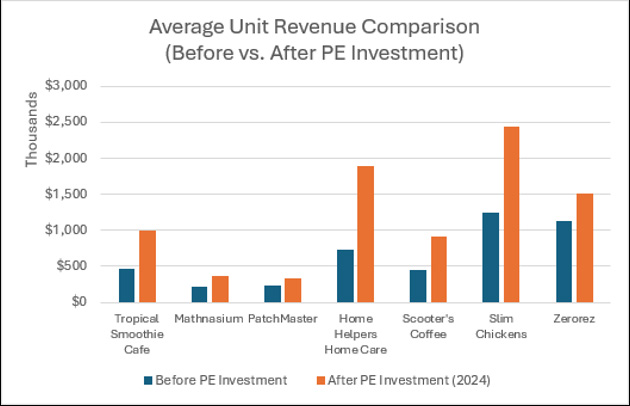
FRANdata analyzed several franchise systems that received private equity backing and found a consistent pattern: Average unit revenues generally increased after investment. From Tropical Smoothie Cafe to Slim Chickens, PE involvement often coincided with strong sales performance, suggesting that while ownership transitions can shift a brand’s culture, they also tend to bring operational scale and growth discipline that boost the bottom line. The long and short of it is this: Most franchises with PE managers generate more sales. Everyone likes sales.
As COO, Paul Wilbur is instrumental in building the research and consulting framework at FRANdata. He plays an integral role in the strategic development of FRANdata's suite of franchise solutions. Nearly a 20-year veteran at the company, he is the franchise business model expert and plays a key role in fostering strategic advisory relationships with some of FRANdata's biggest clients.